Pinyin initial: "m"
/m/
The Pinyin initial "m" is used in the first half of Pinyin syllables. In MandarinBanana's mnemonic system, "m" belongs to the group of Pinyin initials which are represented in mnemonics by men. You can visit the Pinyin index to see all Pinyin syllables from this mnemonic group, or to see all Pinyin syllables "m" can appear in.
Pronunciation Tips
The “Cheat Code”
Think of the m in “mom”—a smooth humming sound made with lips closed, with no puff of air.
Mouth Mechanics (step-by-step)
- Bring your lips together gently (closed, but not tight).
- Keep your teeth slightly apart behind the lips (don’t clench).
- Relax your tongue—it can rest naturally in the mouth; it does not need to touch anything special.
- Turn on your voice: make a steady, buzzy hum “mmmm…”.
- You should feel vibration in your lips and nose.
- Open into the vowel smoothly (don’t “pop” the lips open).
- Example flow: m…a → ma, m…wo → mo, m…ə(n) → men, m…ə(ng) → meng.
Key feeling: continuous sound from m into the final, like one connected motion.
English Approximation (what to copy)
These English words contain essentially the same m sound. Copy only the m part:
- “me” — the m at the beginning is the target sound.
- “mother” — the first sound m is the target sound.
- “summer” — the middle -mm- is the target sound (smooth and voiced).
What to focus on: in English, m is already voiced and made with closed lips, which matches Mandarin m well. Your main job is to keep it smooth, and then open directly into the vowel that follows.
Common Mistakes (English-speaker traps)
- Adding a “pop” or extra release: Don’t explode into the vowel. Mandarin m should flow into the vowel without a hard burst.
- Adding an extra vowel before the syllable: Avoid saying something like “uh-ma” or “em-ma.” Start directly with m.
- Nasal blockage / “stuffy” m: If you pinch off airflow so it can’t resonate, the sound gets tight. Keep the hum relaxed.
- Letting the vowel change the m: The m stays the same no matter what comes next (a, o, ai, ao, en, eng, etc.). Only the following vowel/final changes.
Practice Pairs (visualizing the sound)
Pinyin (with m) English approximation What to copy from English ma “mom” the initial m (closed lips + voiced hum) mo (pronounced like “mwo”) “more” (said quickly) start with m, then move toward a rounded w/o feeling mai “my” the m + the glide into -y (ai-like movement) mei “may” the m + the smooth move into ay (similar direction) mao “mouse” the m + the move into an ow-like sound mou “mow” the m + oh/ow-type rounding after it men “m” + “un” (as in “sun”) start with m, then a relaxed “uh” before n meng “m” + “ung” (as in “sung”) start with m, then a central “uh,” ending with -ngNote: These English words are approximations for the full syllable. The main target here is the initial m: closed lips + voiced hum + smooth transition.
Comparisons and Caveats (similar sounds to watch out for)
m vs. b / p
- m is nasal: air resonates through the nose while the lips are closed. You can hum it and hold it: “mmmm…”
- b / p are stops: lips close and then release; you can’t “hold” them the same way.
- If you can sustain the sound (“mmmmmm”), it’s m, not b/p.
m is stable across finals
- Mandarin m stays the same whether the final is:
- open vowel: ma
- with a glide: mai, mei, mao, mou
- with a nasal ending: man, men, mang, meng
- Don’t “reshape” the m—only change the mouth shape for the vowel after the m.
m + -n vs. m + -ng
- man / men end with -n (tongue tip moves toward the front area behind the upper teeth).
- mang / meng end with -ng (back of the tongue lifts; the ending feels farther back).
- Keep the m identical; the difference is in the ending, not the start.
m before “o” (spelled “mo”)
- In this system, mo has a w-like glide after m (it’s closer to “mwo…”).
Keep the m closed-lip hum, then round the lips as you move into the vowel.
Pinyin with m
Mnemonics for m
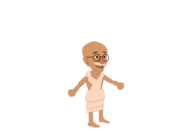
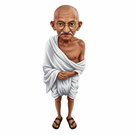
M is for Mahatma Gandhi.
Prompt snippets
Mahatma Gandhi has large, expressive dark eyes framed by his signature thin, circular wire-rimmed spectacles. He wears a simple dhoti and simple hand-stitched leather sandals.
Characters with m