Pinyin final: "ao2"
/au̯˧˥/
The Pinyin final "ao2" is used in the second half of Pinyin syllables. In MandarinBanana's mnemonic system, the second half of a Pinyin syllable is always represented by a location. You can visit the Pinyin index to see all Pinyin syllables from this mnemonic group, or to see all Pinyin syllables "ao2" can appear in.
Pronunciation Tips
The “Cheat Code”
Think of “ow” in “cow”, but make it cleaner and shorter, and say it with Tone 2 (rising, like a question).
Mouth Mechanics (Step-by-step)
- Start with an open “ah” mouth: Jaw drops slightly, lips relaxed and not rounded yet (like the a in “father,” but shorter).
- Tongue stays low and relaxed: The front of the tongue rests comfortably; don’t tense it or pull it back hard.
- Glide into “oh/oo”: As you move to the second part of the vowel, round your lips into a small “O” shape (as if about to whistle lightly).
- Keep it one smooth syllable: It’s one vowel that moves, not two separate vowels.
- Add Tone 2 (ao2): Start a bit lower and rise through the vowel. The rise should feel natural and smooth, not dramatic.
English Approximation
These English examples are close in shape (a vowel gliding from open to rounded). Use them as a starting point, then adjust:
- “cow” / “how”: The “ow” is similar to Chinese ao, especially the smooth glide.
Adjustment: In many English accents, this “ow” may start too far forward (a bit like “eh-ow”). For Chinese ao, start with a clear “ah”. - “loud”: The “ou” shows the same idea: open → rounded.
Adjustment: Keep it short and single, not drawn out. - “ouch!”: The “ou” is close when said quickly.
Adjustment: Avoid exaggerating the “oo” ending; let it finish naturally.
If your English “ow” begins with something like “eh” (as in “keh-ow”), consciously replace that beginning with a pure “ah”.
Common Mistakes (English speakers)
- Mistake 1: Starting too “eh”
Many English speakers produce something like “eh-ow”. Chinese ao should start as a more direct “ah-”. - Mistake 2: Splitting it into two syllables
Don’t say “ah—oh” as two beats. It must be one smooth glide. - Mistake 3: Over-rounding or over-holding the ending
Avoid a strong, long “-oo” ending (like “cowww”). Keep the glide compact. - Mistake 4: Forgetting the rise (Tone 2)
ao2 must rise in pitch across the syllable. Don’t keep it flat.
Practice Pairs (Pinyin ↔ English approximation)
Pinyin (Tone 2) English Approximation What to copy from English What to change to match Mandarin ao2 “ow!” (as in “ow, that hurt!”) The quick open→rounded glide Start more like “ah”, then round bao2 “bow” (as in “bow and arrow”) The -ow glide Keep it shorter, and make the vowel start “ah”-like pao2 “pow!” The strong -ow Don’t drag the ending; keep Tone 2 rise dao2 “Dow” (as in “Dow Jones”) The -ow Make the start a clearer “ah” tao2 “tau” (as in “tau protein,” said by many speakers as “tow”) The -ow shape Keep it one smooth syllable, rising lao2 “loud” (first part) The open→rounded motion Don’t add extra consonant; keep the ending light hao2 “how” The -ow glide Start with “ah,” not “eh”; keep Tone 2 shao2 “shower” (first syllable “show-” for many speakers) Lip rounding and glide Don’t turn it into pure “oh”; it must begin more open (“ah”) zhao2 “jow” (rare, but “jowl” begins similarly) The -ow glide Keep the vowel clean and rising; don’t over-roundNote: These English words are only approximations; the goal is to copy the vowel movement (open → rounded) while keeping it short, smooth, and rising.
Comparisons & Caveats (similar Pinyin sounds)
ao vs. ou
- ao starts more open (more like “ah”) and then rounds.
- ou starts more rounded/closed (more like “oh”) and stays closer to that shape.
Practical tip: If your lips round early, you’ll drift toward ou. For ao, keep lips relaxed at the start, then round later.
ao vs. a (as in “a” / “ai” family)
- a is a more steady open vowel (not much gliding).
- ao is a clear glide: open → rounded.
Practical tip: If it sounds like a plain “ah” with no movement, you’re missing the -o glide.
ao after i/y (as in miao2, xiao2, jiao2, qiao2, yao2)
In syllables like miao2, xiao2, jiao2, qiao2, yao2, you’ll feel a quick “y” glide into ao: It’s like a fast “y-” leading into the same ao vowel shape.
Practical tip: Don’t turn it into two syllables (“mee-ow”). Make it one syllable with a quick front glide, then the ao movement, all under Tone 2.
Tone reminder for ao2
Tone 2 is a smooth rise across the whole syllable. Don’t place the rise only at the end; let the pitch climb naturally from start to finish.
Pinyin with ao2
Mnemonics for ao2
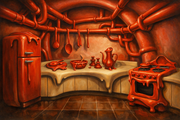
In the aorta’s kitchen.



Prompt snippets
Scene setting: a red kitchen in a tubular red pipe. Red plastic pipes are running along the walls in seemingly random arrangements. The kitchen counters are crafted from smooth beige plastic, supporting cooking implements seemingly made from red organic material. The floor is tiled with dark brown tiles. A fridge and a stove are set up at either side of the scene. Red droplets are floating through the scene.
Image style: A dream-logic composition inspired by 20th-century Surrealism, featuring juxtaposed realities and impossible physics. The scene blends sharp, academic realism with hallucinatory subjects, such as melting solid objects, floating architectural elements, or organic-mechanical hybrids.
Characters with ao2