Pinyin final: "ao3"
/au̯˧˩˧/
The Pinyin final "ao3" is used in the second half of Pinyin syllables. In MandarinBanana's mnemonic system, the second half of a Pinyin syllable is always represented by a location. You can visit the Pinyin index to see all Pinyin syllables from this mnemonic group, or to see all Pinyin syllables "ao3" can appear in.
Pronunciation Tips
The “Cheat Code”
ao3 is like saying “ow” in “cow,” but in 3rd tone: dip down, then rise, while your mouth glides from open “a-” to a rounded “-o/w”.
Mouth Mechanics (step-by-step)
- Start open and low (the “a” part):
- Drop your jaw.
- Keep your lips relaxed and unrounded (not smiling, not puckered).
- Your tongue rests low in the mouth (think “ah” as in a doctor’s check).
- Glide to the “o/w” end:
- As you continue the sound, raise the back of the tongue slightly.
- Round your lips gently as if preparing to say a soft “oh.”
- The sound naturally tightens into a brief “w-like” off-glide at the end.
- Add the 3rd tone shape:
- Start mid, dip lower, then rise (a “valley” shape).
- Keep the mouth movement smooth; don’t break it into two separate vowels.
- Finish cleanly:
- Let the rounded ending be brief—don’t hold a long English “ohhh.”
English Approximation (and how to adjust it)
These are close, but not identical. Use them as a starting point:
- “cow” — the “ow” is the closest match.
- Match the glide from open to rounded, but make the final rounded part shorter than many English accents do.
- “loud” — the “ou” is similar.
- Keep it one smooth glide, not “la-ood.”
- “how” — again, focus on the “ow” part.
- Then apply the 3rd tone: dip then rise while saying it.
Key adjustment for accuracy: English “ow” often ends with a stronger, longer rounding. In Mandarin ao, the ending is rounded but quick, with most of the “weight” in the open beginning.
Common Mistakes (English speakers)
-
Mistake 1: Turning it into “ah-oh” (two syllables).
ao must be one syllable, one continuous glide. -
Mistake 2: Ending too “oh”-heavy.
Don’t hold a long “oh.” The rounded ending is short and light. -
Mistake 3: Using a tense “aw” (like “law”) instead of a glide.
“aw” is too fixed; ao must clearly move from open to rounded. -
Mistake 4: Forgetting the 3rd tone motion.
ao3 is not flat. Make the voice dip and then rise, even in short words.
Practice Pairs (visual sound anchors)
Pinyin (3rd tone) Closest English anchor What to copy ao3 “ow” (as in cow) The single glide from open → rounded bao3 “bow” (as in take a bow) Start with b, then ow-glide + dip-rise tone pao3 “pow” (comic “pow!”) Same ow-glide; keep the ending short mao3 “Mao” (like “cow” with m) / “mow” (approx.) Prefer cow-type “ow” glide over pure “oh” dao3 “dow” (as in Dow Jones) Clear open-to-rounded glide gao3 “gow” (approx.) Keep it one syllable, rounded finish brief hao3 “how” Copy the “ow” but add 3rd tone dip-rise(English anchors are approximations; the goal is the glide shape and tone contour.)
Comparisons & Caveats (similar Pinyin to watch out for)
A) ao vs ou
- ao starts more open (bigger jaw drop) and then rounds: a → o/w.
- ou starts already rounded and stays more “oh-like”: o → u/w.
Tip: If your lips are rounded from the very start, you’re drifting toward ou, not ao.
B) ao vs an / ang
- an/ang have a nasal ending (air continues through the nose).
- ao is not nasal—it ends with rounding, not with “n/ng.”
Tip: If you feel a strong “ng” or buzzing in the nose at the end, you’ve added a nasal that doesn’t belong.
C) ao vs iao (as in xiao3, jiao3, biao3)
- iao has a quick “y” glide at the front (like starting with “ya-”), then it moves into ao.
- Example: xiao3 is essentially (y) + ao3 in one smooth syllable.
Tip: For iao, start with the tongue already higher and forward (a light “y” start), then drop open and glide to the rounded ending.
D) Tone reminder
The 3rd tone often makes learners slow down and accidentally split the vowel. Keep the sound connected: the tone changes the pitch, not the syllable structure.
Pinyin with ao3
Mnemonics for ao3
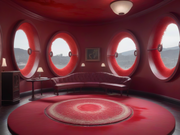
In the aorta’s living room.

Prompt snippets
Scene setting: a huge organic, crimson red lounge hall living area. The walls are organically curved without any corners or edges and made out of a soft, damp material. Circular tunnels in the wall lead into darkness. Large red sofas are set up on red carpets. Red droplets are floating through the scene.
Image style: A dream-logic composition inspired by 20th-century Surrealism, featuring juxtaposed realities and impossible physics. The scene blends sharp, academic realism with hallucinatory subjects, such as melting solid objects, floating architectural elements, or organic-mechanical hybrids.
Characters with ao3