Pinyin initial: "n"
/n/
The Pinyin initial "n" is used in the first half of Pinyin syllables. In MandarinBanana's mnemonic system, "n" belongs to the group of Pinyin initials which are represented in mnemonics by men. You can visit the Pinyin index to see all Pinyin syllables from this mnemonic group, or to see all Pinyin syllables "n" can appear in.
Pronunciation Tips
The “Cheat Code”
Think of the n in “no”—a clean, buzzy nose sound made with the tongue touching just behind your top front teeth.
Mouth Mechanics (step-by-step)
- Relax your lips (no rounding is required just to make n—the following vowel may shape the lips, but the n itself doesn’t need extra lip work).
- Put the tip of your tongue on the gum ridge right behind your upper front teeth (the same place you use for English n in “now”).
- Seal the mouth at the tongue tip: the front of your mouth is “closed” by the tongue touching the gum ridge.
- Let the sound come out through your nose: lower the soft “back part” of the roof of the mouth (you don’t need to name it—just feel that the air escapes through the nose).
- Turn on your voice immediately (your vocal cords vibrate): Mandarin n is normally voiced.
- Release smoothly into the vowel without an extra pop or breath. The n should feel quick and clean.
English Approximation (2–3 words)
- “no” — the n at the start of no matches well.
- “name” — the n at the start of name matches well.
- “never” — the n at the start of never matches well.
What part matches: In each word, it’s the very first sound (the n).
How to aim for Mandarin accuracy: Keep it simple and light—touch behind the upper teeth, send air through the nose, and glide straight into the vowel.
Common Mistakes (English speakers)
- Adding a “d” sound (making it like “dn-”): keep it a pure n, not “nd.”
- Letting air burst out of the mouth: n should be nasal, with airflow through the nose, not a mouthy release.
- Tongue too far back: don’t place the tongue in the middle of the mouth; it should touch just behind the upper teeth.
- Over-holding the n: in normal speech, Mandarin n is usually quick, then you move into the vowel.
Practice Pairs (Pinyin ⇄ English approximation)
These English words are pronunciation anchors (they won’t match Mandarin tones, and some vowels differ; focus on the initial n).
Pinyin syllable English anchor What to copy na- “nah” (as in “nah, I’m good”) Start with the same n; open into ah ne- “nuh-” (start of “nudge”) Same n; then a relaxed uh-like vowel nai- “nigh” / “ny” (as in “nylon,” first sound only) Same n; then glide toward an “eye”-like sound nei- “nay” Same n; glide toward “ay” nao- “now” Same n; then “ow” glide nou- “no” Same n; then “oh/oo”-like glide nan- “noun” (start only) Same n; then open vowel, ending with n closure nen- “none” (slowly, careful) Same n; aim for a relaxed “uh,” end with n nang- “nong” (as in “Kong,” with an n in front) Same n; end with a back -ng resonance neng- “nung” (like “hung” with an n) Same n; relaxed vowel, end with -ngComparisons & Caveats (similar Pinyin sounds)
n- vs l- (the #1 confusion for English speakers learning Mandarin)
- n-: tongue touches behind upper teeth and air goes through the nose (you can feel nose vibration).
- l-: tongue touches in a similar place, but air goes around the sides of the tongue through the mouth, not the nose.
Quick test: Pinch your nose gently. If you can still say it clearly, it’s probably l-. If it sounds blocked, it’s n-.
n- in Mandarin is steady—don’t “color” it with the vowel
English speakers sometimes change the n depending on the next sound (making it too “wide,” “tight,” or overly strong). In Mandarin, keep n consistent: tongue tip behind upper teeth, nasal airflow, then move to the vowel.
Watch the endings: -n vs -ng (especially in nan vs nang, nen vs neng)
Using the provided syllables:
- nan ends with -n: the tongue tip returns to the same front contact area (behind upper teeth) to close the final.
- nang / neng end with -ng: the tongue tip is not making the final closure; instead, the back of the tongue creates the -ng resonance.
Practical feel:
- -n feels like a front-of-mouth finish.
- -ng feels like a back-of-mouth finish with a more “humming” quality.
Pinyin with n
Mnemonics for n
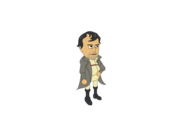
N is for Napoleon.

Prompt snippets
Napoleon is a man of compact, sturdy build and a stoic, calculating expression. He has a pale, marble-like complexion and piercing, steel-grey eyes set beneath a prominent, furrowed brow. His dark auburn hair is cut in a short "Brutus" style, with thin strands often falling over his forehead. His most defining feature is his black felt bicorne hat, worn "en bataille" (sideways), parallel to his shoulders. He wears a dark forest-green coat with white lapels and scarlet cuffs, adorned with simple gold epaulettes. His right hand is habitually tucked into the front of his white waistcoat, a gesture of composed authority. He wears snug white breeches and high, polished black leather riding boots that reach his knees. A slim, gold-hilted ceremonial sword hangs at his hip from a white leather belt.
Characters with n