Pinyin final: "a2"
/a˧˥/
The Pinyin final "a2" is used in the second half of Pinyin syllables. In MandarinBanana's mnemonic system, the second half of a Pinyin syllable is always represented by a location. You can visit the Pinyin index to see all Pinyin syllables from this mnemonic group, or to see all Pinyin syllables "a2" can appear in.
Pronunciation Tips
The “Cheat Code”
Think of a relaxed, open “ah” (like a doctor checking your throat) and say it with Tone 2: a smooth rise, like a mild “Really?” in English.
Mouth Mechanics (step-by-step)
- Open your mouth vertically: Drop your jaw so there’s plenty of space—this is a big, open vowel.
- Keep your lips neutral: No rounding, no smiling—just relaxed.
- Tongue stays low and flat: Let the tongue rest comfortably with the tip near the bottom front teeth (not pulled back).
- Aim the sound straight out: The vowel should feel “open” and centered, not pinched or nasal.
- Add Tone 2 (rising): Start at a comfortable mid pitch and glide upward smoothly (not a sudden jump).
English Approximation (what to copy, what to change)
This vowel is very close to the open “ah” sound in many English accents, but English often changes it depending on the word and region. Use these as targets:
- “spa” — use the “a” in spa as your vowel target (a pure, open “ah”).
- “father” — use the first “a” sound in father (again, the open “ah”).
- “hot” (only for speakers who pronounce it with a very open vowel) — use the vowel in hot, but make it less rounded and more like a clear “ah.”
Important adjustment to make it more Mandarin-like:
In Mandarin, a should be a steady, pure vowel—avoid turning it into a diphthong (no “uh” off-glide). Keep it as one clean “ah” from start to finish while the pitch rises.
Common Mistakes (English-speaker traps)
- Accidentally rounding the lips and drifting toward an “aw” sound (like law). Keep lips neutral.
- Adding an extra ending sound (“ah-uh” or “aɹ”): English often colors vowels with a final glide or “r.” Mandarin a should not.
- Making Tone 2 too dramatic: It’s a smooth rise, not a sharp jump or a question-mark spike.
- Tensing the throat: The sound should be open and easy; don’t “push” it.
Practice Pairs (Pinyin vs. English approximation)
Pinyin (Tone 2) Approx. English cue What to copy a2 “spa” The open ah vowel; add a smooth rising pitch ba2 “bah” (as in “bah!”) Clean ah after b pa2 “pa” (as in “pa-pa”) Same vowel; start with a clear p (light, not “puh”) ma2 “ma” (as in “mama”) Open ah after m fa2 “fa” (musical “fa”) Open ah after f da2 “da” (as in “da-da”) Open ah after d (keep vowel pure) la2 “la” (musical “la”) Open ah after l ga2 “ga” (as in “gaga”) Open ah after g (no extra vowel) ha2 “ha!” (a laugh) Breath plus ah; keep it open and rising sha2 “shah” “sh” + open ah zha2 “jar” (approx.) Start like “j” but pull the tongue back more; no English “r” za2 “cats” (final ts, then add ah) Think ts + ah (but smoother as one syllable) ya2 “yah” A light y glide into open ah jia2 / qia2 / xia2 “yard” (approx.) Start with a y-like glide into ah; keep vowel open wa2 “wa!” A quick w into open ah hua2 “wah” (with extra breathiness) h/w-like start, then open ahNote: The English words are only cues. Your goal is the same clean open “ah” vowel every time, plus Tone 2.
Comparisons & Caveats (how a2 differs from similar sounds)
- a (as in a2) vs. o (as in “bo”, “po”)
- a is a wide-open “ah” with neutral lips.
- o is usually more rounded and can sound closer to “oh/aw.”
If your a starts sounding like “aw,” you’ve drifted toward o-like rounding.
- a (a2) vs. e / ê (varies by syllable)
- a is fully open.
- e/ê are more mid and can feel “higher” in the mouth, less open.
If your jaw isn’t dropped much, you may be accidentally aiming for e-type vowels.
- a2 vs. ai2 / ao2 (don’t add a glide)
- a is one pure vowel.
- ai adds a clear “ee-ish” ending glide; ao adds a rounded/back glide.
If you hear yourself saying “ah-ee” or “ah-oh,” you’re no longer doing plain a.
-
a2 across different initials (keep the vowel stable)
The vowel quality of a should stay essentially the same in ba2, pa2, ma2, fa2, da2, na2, la2, ga2, ha2, sha2, zha2, za2, ya2, wa2, hua2, etc.
What changes is the initial consonant, not the vowel. Don’t let the consonant “pull” the vowel into a different English-like shape. - Tone reminder (Tone 2 = rising, not “question intonation” on the whole sentence)
Tone 2 is a controlled pitch rise on the syllable itself. Keep the vowel steady while the pitch rises smoothly.
Pinyin with a2
Mnemonics for a2
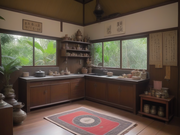
In the ashram’s kitchen.

Prompt snippets
Scene setting and image style: a nostalgic 90s analog color photograph captures the busy ashram kitchen, featuring soot-stained walls and large brass cooking pots resting on traditional mud stoves. Hanging above the main hearth is a framed, fading print of the goddess of nourishment, adorned with fresh marigold garlands and red kumkum marks. On a small, dedicated shelf nearby, an earthen oil lamp flickers softly next to a small metal plate holding offerings of rice and a single hibiscus flower. Shelves overflow with stainless steel stacked tiffins and burlap sacks of lentils and spices. The distinctive film grain and warm, slightly soft palette of vintage print film enhance the rustic, devotional atmosphere of communal food preparation.
Characters with a2