Pinyin final: "e5"
/ɤ/
The Pinyin final "e5" is used in the second half of Pinyin syllables. In MandarinBanana's mnemonic system, the second half of a Pinyin syllable is always represented by a location. You can visit the Pinyin index to see all Pinyin syllables from this mnemonic group, or to see all Pinyin syllables "e5" can appear in.
Pronunciation Tips
Pinyin Final: e5 (neutral tone)
The “Cheat Code”
Think of a relaxed “uh” sound made far back in the mouth, like the unstressed vowel in “taken” (the -en), but darker/backer.
Mouth Mechanics (step-by-step)
- Relax your jaw and open your mouth a small amount (not wide like “cat,” not tight like “see”).
- Keep your lips neutral—no rounding, no smile.
- Pull the tongue slightly back so the middle/back of the tongue feels “retracted,” but don’t tense it.
- Let the sound resonate in the throat/back of the mouth (it should feel a bit “deeper” than many English vowels).
- For e5 after d/n/l/zhe (as in de5, ne5, le5, zhe5), keep it very short and light, because it often functions like a grammatical particle.
- Do not add an “r” sound at the end. Stop cleanly after the vowel.
English Approximation (how to get close)
This vowel is not a perfect match to a single English vowel. Use these approximations and adjustments:
- “taken” (the second vowel, -en): say TAK-ən and focus on the unstressed “uh” at the end.
- Adjustment: make that “uh” a bit farther back in your mouth (darker).
- “sofa” (the final -a): SO-fə ends with a relaxed vowel.
- Adjustment: again, pull it slightly back; keep lips neutral.
- “the” (when said quickly before a consonant, like “the book”): many speakers use a reduced vowel close to “uh.”
- Adjustment: make it less fronted than your usual “the.”
If your English “uh” tends to be very central, the key modification is: move the vowel subtly backward without rounding the lips and without tightening the tongue.
Common Mistakes (English speakers)
- Turning it into “duh / nə / luh” with a strong American “uh”: English “uh” can be too central or too open. Aim for slightly back and compact.
- Adding an “r” color (like “duhr”): Mandarin e5 ends cleanly, no “r” unless the word explicitly has -r (儿化).
- Saying “day / nay / lay”: don’t make it a clear English “ay” diphthong. No glide.
- Overstressing particles like de5 / le5: keep them light and quick (neutral tone).
Practice Pairs (visualizing the target)
| Pinyin syllable (with e5) | Closest English “helper” | What to copy from the English word | |—|—|—| | de5 | “taken” (…-en) | the weak, quick “uh” sound at the end, but slightly back | | ne5 | “sofa” (…-a) | the relaxed final vowel (no stress), keep lips neutral | | le5 | “the” (in “the book”) | the reduced vowel quality, but avoid “r”-coloring | | zhe5 | “taken” (…-en) | same reduced ending vowel; keep it short after the consonant |
Use the English word only as a launch pad; then “darken” it slightly by pulling the tongue back.
Comparisons & Caveats (similar Pinyin sounds)
- e5 vs. -ei (as in “bei”)
- -ei is a clear vowel that glides (like “bay”).
- e5 is single, short, and flat—no glide.
- e5 vs. -en / -eng endings
- -en / -eng have a nasal ending (air flows through the nose at the end).
- e5 has no nasal ending—stop after the vowel.
- e5 after different initials can sound slightly different
- After d/n/l/zhe (e.g., de5, ne5, le5, zhe5), the vowel is a back, “throaty” e-like sound (as reflected by the provided pronunciations).
- But ye5 / mie5 / lie5 / jie5 show that written “e” can represent a different vowel quality when preceded by y/i (it becomes more like “ye”).
Key takeaway: the “e” spelling is not one fixed sound in all contexts. This guide targets the final e5 used in syllables like de5, ne5, le5, zhe5, me5, where it is the back, relaxed vowel used especially in neutral-tone particles.
- Neutral tone behavior
- In real speech, e5 is often very short, especially in grammar words (的 de5, 了 le5, 呢 ne5, 着 zhe5).
- Aim for clarity without heaviness: correct shape, light delivery.
Pinyin with e5
Mnemonics for e5
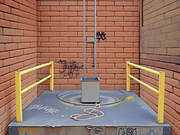
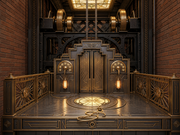
On the elevator’s roof.
Prompt snippets
Scene setting and image style: a polished steel elevator car top is surrounded by decorative bronze safety railings with stylized sunburst patterns and intricate geometric motifs. Overhead, the open shaft reveals elaborate black iron girders and large brass pulleys adorned with subtle chevron etchings. Soft, warm light spills down through a decorative art glass panel set into the metal roof, illuminating the polished, industrial-glamour style machinery. A pair of custom-designed, stepped-arch access doors lead into the elevator workings, flanked by elegant, illuminated floor indicator dials. The metal surfaces showcase an array of fine linear engravings and symmetric designs, maintaining a luxurious feel within the functional, industrial space.
Characters with e5