Pinyin final: "an2"
/a˧˥n/
The Pinyin final "an2" is used in the second half of Pinyin syllables. In MandarinBanana's mnemonic system, the second half of a Pinyin syllable is always represented by a location. You can visit the Pinyin index to see all Pinyin syllables from this mnemonic group, or to see all Pinyin syllables "an2" can appear in.
Pronunciation Tips
The “Cheat Code”
Think of “an” as the vowel in “father” followed by a light n sound, all said with Tone 2: start mid, glide up (like a calm “Huh?”).
Mouth Mechanics (how to physically make an2)
- Open the jaw comfortably (not tight, not a smile).
- Lips relaxed and neutral (no rounding like “ooh”).
- Say a clear “ah” vowel: the tongue stays low and flat, with the middle of the tongue relaxed.
- Close into “n” at the end:
- Bring the tip of the tongue gently to the ridge just behind your top front teeth (the “bumpy” area).
- Let the air go through your nose for the final n.
- Tone 2 (rising) on the whole syllable: start at a comfortable mid pitch and glide upward smoothly. Avoid a big dramatic jump; keep it natural and even.
What it should feel like: open “ah” → quick, neat “n” closure, with a smooth rise in pitch.
English Approximation (and how to adjust it)
English doesn’t have an exact match, but you can get close:
- “on” (as in “on”)
- Use the n ending, but replace the English “aw/ɒ” quality with a more open “ah” (like father).
- So it’s not “awn,” not “ohn”—it’s “ahn”.
- “ahn” (the sound people make in hesitation, like “ahn…”)
- This often lands close to the open ‘ah’ you need.
- Then finish with a clean “n”.
- “father” + n (build-it-yourself method)
- Say “fa-” from father (just the vowel part), then add n: “ah” → “ahn.”
- Add the rising tone: an2.
Key adjustment for most English speakers: keep the vowel open and “flat” (ah), not rounded or “nasalized” too early.
Common Mistakes (what English speakers usually do wrong)
- Using the wrong vowel: saying something like “ant” (too “æ” as in cat) or “awn” (too rounded). The vowel should be closer to “ah” as in father.
- Adding an extra consonant: saying “an(d)” or “an(t)”. Chinese -n ends cleanly—no extra stop at the end.
- Nasalizing too early: letting the vowel become nasal from the start (“ããn”). Keep the vowel mostly oral, then close to n near the end.
- Forgetting Tone 2: speaking it flat or dropping. an2 must rise.
Practice Pairs (visual anchors)
These English words are approximations to help you “aim” your mouth; the goal is the Chinese sound.
Pinyin (Tone 2) Closest English anchor What to copy / what to change an2 “on” Keep the final n, but change the vowel to open “ah” and add a rising tone man2 “ma” (as in “ma, pa”) + n Use the open “ah”, then close to n (no “man” like mæn) fan2 “fa” (as in “fa-la-la”) + n Keep open ah, finish with n; avoid “fan” like fæn wan2 “one” (many accents) Keep w + n shape, but make the vowel more open ‘ah’ than English “one”Comparisons & Caveats (similar Pinyin you must not confuse)
an vs ang
- an ends with -n: tongue tip touches just behind the top teeth ridge.
- ang ends with -ng: the back of the tongue rises; the tongue tip does not make the same front “n” closure.
Practical test: if you feel the closure in the front, it’s -n (an). If you feel it in the back, it’s -ng (ang).
an vs en
- an uses an open “ah” vowel.
- en has a more “uh/eh” type vowel quality (less open).
If your jaw is more open and the vowel sounds like father, you’re closer to an.
an changes after different initials (same ending goal)
The final written -an is consistent, but some syllables that look like -an are actually pronounced with a fronted “yeh/eh” quality because of the i / ü glide in front:
- -ian / -uan / -üan / -yan / -yuan / -xuan / -quan, etc.
- Examples from your list: mian2, tian2, nian2, lian2, xian2, yuan2, quan2, yan2, xuan2, tuan2, huan2, ruan2, cuan2, chuan2.
- What to watch for: you may hear/feel a quick “y/ü” glide before the vowel, and the vowel can sound closer to “yeh/eh” in many of these syllables—but they still end with the same -n closure.
Tone reminder (Tone 2)
No matter which initial you add (m-, f-, n-, l-, ch-, r-, z-, c-, etc.), keep the syllable’s pitch as a smooth rise: mid → higher, not flat, not dipping, not sharply jumping.
Pinyin with an2
Mnemonics for an2
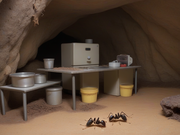
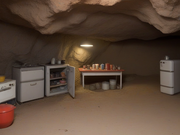
In the anthill’s kitchen.

Prompt snippets
Scene setting: a bustling kitchen chamber forms the heart of the ant hill, with irregular tunnels radiating outwards. Seeds and fibers for provisions are stacked on shelves of thin, sun-dried clay slabs. A communal fire pit occupies the center. Overhead, clay pots hang from hemp twine. A steady stream of ant workers moves about the floor.
Image style: hand-sculpted stop-motion animation still. Materials consist of matte polymer clay with visible slight thumbprints, blended with fuzzy needle-felted wool and soft roving fibers. Soft studio macro photography, shallow depth of field with a blurred background, high tactile contrast, and 24fps cinematic lighting.
Characters with an2