Pinyin initial: "s"
/s/
The Pinyin initial "s" is used in the first half of Pinyin syllables. In MandarinBanana's mnemonic system, "s" belongs to the group of Pinyin initials which are represented in mnemonics by men. You can visit the Pinyin index to see all Pinyin syllables from this mnemonic group, or to see all Pinyin syllables "s" can appear in.
Pronunciation Tips
The “Cheat Code”
Think of the normal English “s” in “see”—a clean, steady hiss—then keep it tight and straight (don’t let it turn into “sh” or “z”).
Mouth Mechanics (step-by-step)
- Teeth: Bring your upper and lower front teeth close together (not clenched), leaving a thin gap for air.
- Lips: Keep lips relaxed and neutral (no rounding, no smiling exaggeration).
- Tongue tip: Place the tongue tip just behind your lower front teeth (or lightly touching the lower teeth).
- Tongue shape: Raise the front “blade” of the tongue toward the roof of the mouth behind the upper teeth, forming a narrow groove down the center of the tongue.
- Airflow: Push air straight through the groove so it creates a focused hiss.
- Voice: Keep your vocal cords off (it should feel like a whispery hiss, not a buzzing sound).
- Connect to the vowel: Hold the hiss briefly, then move directly into the final (a, e, ai, ao, ou, an, ang, eng, or the special “i” in si).
English Approximation (with clear matching points)
The basic sound does exist in English; what matters is keeping it pure “s”.
- “see” — the very beginning s- matches well.
- “sip” — the beginning s- matches well.
- “bus” — the ending -s matches well (focus on the hiss, not the vowel).
How to modify your English “s” to match Mandarin s:
- Make it unvoiced (no throat vibration), and keep the sound forward (air aimed toward the front teeth), not “wide” or “fuzzy.”
Common Mistakes (English-speaker traps)
- Turning it into “sh” (too far back in the mouth, lips rounding): s must stay front and sharp, not “shoe”-like.
- Voicing it into “z” (buzzing): Mandarin s should be unvoiced—no vibration in the throat.
- Adding a little “t” before it (like “ts”): keep it a smooth hiss, not a “ts” pop.
- For “si”: saying English “see”: Mandarin si is not “see.” The vowel is a special, tight, tongue-forward sound that’s closer to a “buzzed” vowel-like sound after s (students often mistakenly add an English “ee”).
Practice Pairs (Pinyin vs. English approximation)
These English words are approximations to anchor the initial s-. Focus on matching the starting consonant.
Pinyin (focus: initial s) English anchor What to copy sa- “sah” (as in “Sara” start) The initial s- hiss sai- “sigh” The initial s- before the vowel sao- “sour” (first sound only) The s- and the quick move into a rounded glide sou- “so” The s- plus lip rounding happens on ou, not on s san- “sun” (approx.) The s-; note Mandarin -an is not English “-un” sang- “song” (approx.) The s-; final is -ang (back nasal) sen- / seng- “sun” (approx.) The s-; vowel is a Mandarin “uh”-like sound si- “s” + “(tongue stays high)” Copy s-, then do not add English “ee”Tone reminder: your list shows that tone changes the pitch contour (e.g., si1 vs si4), but the initial s itself stays the same.
Comparisons & Caveats (similar Mandarin sounds to watch)
s vs sh (very common confusion)
- s (拼音 s) is front: tongue stays near the teeth, lips neutral, hiss is sharp.
- sh (拼音 sh) is farther back: tongue curls/backs up more, lips often round slightly, sound is darker.
Quick test: If it starts to feel like the beginning of English “she”, you drifted toward sh, not s.
s vs x
- s is a sharp hiss with the tongue low-front (tip near lower teeth).
- x has a lighter, more “hissy/whispery” quality made with the tongue higher and closer to the roof of the mouth (many English speakers hear it as “sh”-like, but it’s not the same as English “sh”).
Practical cue: If you can say “see” easily, that starting sound is much closer to s than to x.
s vs z / c (Mandarin initials)
- s is only friction (a continuous hiss).
- z and c begin with a brief stop-like contact and come out more like “dz/ts” (an affricate), not a pure hiss.
Practical cue: If you hear or feel a little “t” pop at the beginning, you’re drifting toward c, not s.
Special note on “si”
In the syllables si1 / si3 / si4, the final written -i is not the English “ee” vowel. After s, Mandarin uses a special “i” that keeps the tongue tight and forward, with the syllable sounding closer to “s” + a syllabic, r-like/buzzy vowel quality than “see.” This is why si is often the hardest s- syllable for English speakers even when their consonant s is fine.
Pinyin with s
Mnemonics for s
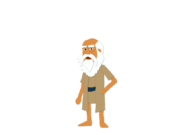
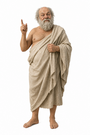
Socrates.
Prompt snippets
Socrates is an elderly ancient Greek philosopher with a distinctive, satyr-like face; featuring a domed, balding head with a fringe of unruly gray hair, prominent bulging eyes, and a broad, flat snub nose. He sports a thick, unkempt white beard and has a sturdy, stocky build. He is dressed in a simple, rough-textured woolen himation (tunic) draped over one shoulder, often depicted barefoot, with an expression of intense, inquisitive wisdom.
Characters with s