Pinyin initial: "t"
/tʰ/
The Pinyin initial "t" is used in the first half of Pinyin syllables. In MandarinBanana's mnemonic system, "t" belongs to the group of Pinyin initials which are represented in mnemonics by men. You can visit the Pinyin index to see all Pinyin syllables from this mnemonic group, or to see all Pinyin syllables "t" can appear in.
Pronunciation Tips
The “Cheat Code”
Think of the “t” in “top” said with a clear puff of air, but without turning it into an English “ch” sound.
Mouth Mechanics (step-by-step)
- Start with your lips relaxed (no rounding needed for the initial itself).
- Put the tip of your tongue lightly against the ridge just behind your top front teeth (the little “bump” you feel there).
- Seal the air briefly: your tongue makes a complete stop, like the beginning of an English t.
- Build gentle pressure, then release cleanly.
- Add a noticeable puff of air right as it releases (you can test this by holding a thin tissue in front of your mouth—the tissue should flick).
- Immediately move into the vowel of the syllable (a, e, ai, ei, ao, ou, an, ang, eng, etc.) without adding an extra vowel like “tuh.”
What it should feel like: a crisp, clean “t” release + breath.
English Approximation (2–3 anchors)
These are not perfect matches, but they get you very close if you copy the puff of air:
- “top” — focus on the very first sound t-; say it a little “breathier” than usual.
- “town” — focus on the t- at the start; the tongue placement is similar, but keep the release clean and avoid “ch.”
- “take” — focus only on the initial t-; again, a clear puff of air.
How to modify English “t” to match Mandarin t-:
English t is often fine, but many speakers either (a) don’t release it clearly, or (b) accidentally slide toward ch before certain vowels. For Mandarin t-, keep it straight, crisp, and strongly aspirated (breathy release).
Common Mistakes (English speakers)
- Not enough air (too weak): Saying Mandarin t- like a soft English d. Mandarin t- needs a clear puff of air.
- Turning it into “ch”: Especially before front vowels, some learners drift toward “ch”. Keep it a clean t release, not “tsh/ ch.”
- Adding an extra vowel: Avoid “tuh-a” for ta. It should be one smooth syllable: ta, not tuh-ah.
- Over-tensing the tongue: Pressing too hard can make the sound harsh or slow. The contact is firm but not strained.
Practice Pairs (visualizing the sound)
Pinyin (Mandarin) English approximation What to copy from English ta- (as in ta1, ta3, ta4) “top” the initial t- with a clear puff of air tai- (as in tai1–tai4) “tie” the initial t-; keep it breathy and crisp tao- (as in tao1–tao4) “town” the initial t-; don’t let it become “ch” tou- (as in tou1–tou5) “toe” the initial t-; keep strong aspiration on release tan- (as in tan1–tan4) “tan” initial t-; then go straight into -an without “tuh” tang- (as in tang1–tang4) “tongue” (approx.) initial t-; then open to -ang (not English “-ung”) teng- (as in teng1–teng2) “tongue” (approx.) initial t-; then aim for a central -eng qualityNote: The English words are only there to anchor the initial t-. The Mandarin finals (like -eng, -ang) will not match the English vowel perfectly.
Comparisons and caveats (similar Pinyin sounds)
t- vs d- (the most important contrast)
- Mandarin t- is aspirated: it has a clear puff of air on release.
- Mandarin d- is unaspirated: it has little to no puff of air and can sound “d-like” to English ears even though it’s not exactly English d.
Quick test: Hold a tissue in front of your mouth: t- should move it more than d-.
t- vs ch-
- t- is made with the tongue at the front ridge behind the teeth and releases cleanly.
- ch- is farther back and has a more “sh/chr” flavor.
If your t- starts to sound like “ch”, bring the tongue contact slightly more forward and keep the release simple.
t- vs z/c
- Mandarin c- is like a ts sound with strong air.
- Mandarin t- is a plain t stop with strong air.
If you hear yourself adding a “s” after t (like “tsao” instead of tao), you’ve drifted toward c-.
Pinyin with t
Mnemonics for t
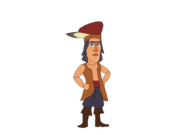
T is for Tecumseh, leader of the Shawnee.

Prompt snippets
Tecumseh is a man of commanding presence and athletic build, with a face that reflects both deep intelligence and iron-clad resolve. He has a warm, copper-toned complexion and piercing, dark hazel eyes that possess a steady, magnetic gaze. His jet-black hair is pulled back, often adorned with three golden eagle feathers that tilt slightly at the back of his head. He pointedly rejects elaborate European uniforms, preferring traditional Shawnee attire: a tan, fringed buckskin tunic and matching leggings, intricately decorated with porcupine quillwork and stained glass beads. Around his neck hangs a large silver gorget (a crescent-shaped medallion), a gift from his British allies, which rests atop a simple medicine bag. A bold, crimson silk sash is tied around his waist, holding a long-handled tomahawk and a silver-hilted hunting knife.
Characters with t