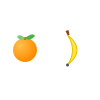
Pinyin final: "ang3"
/a˧˩˧ŋ/
The Pinyin final "ang3" is used in the second half of Pinyin syllables. In MandarinBanana's mnemonic system, the second half of a Pinyin syllable is always represented by a location. You can visit the Pinyin index to see all Pinyin syllables from this mnemonic group, or to see all Pinyin syllables "ang3" can appear in.
Pronunciation Tips
The “Cheat Code”
Think of “ah” + the “ng” in “sing,” said as one smooth sound, with the voice doing a third tone dip (goes down, then comes back up).
Mouth Mechanics (step-by-step)
- Start with an open “ah” vowel:
- Jaw comfortably open.
- Lips relaxed (not rounded, not smiling).
- Tongue low and flat in the middle of the mouth.
- Aim the vowel slightly back:
- Keep the “ah” feeling more like the start of “father” than the “a” in “cat.”
- Don’t push it forward in the mouth.
- Close into “-ng” (nasal ending):
- Without changing the lip shape much, lift the back of your tongue toward the soft, back part of the roof of your mouth.
- The tongue tip stays down and relaxed (it does not touch behind the teeth).
- Let the sound go through the nose at the end:
- As you make the “-ng,” air flows through your nose.
- The ending should feel like the end of si-ng / lo-ng, not like an English “n.”
- Add third tone (ang3):
- Start mid, dip down, then rise again.
- Keep the throat relaxed so the pitch change is smooth, not strained.
English Approximation (2–3 words + what matches)
Because English doesn’t have exactly the same vowel quality in all accents, use these as targets and then adjust:
-
“song” (the “-ong” part):
Use the final “-ng” (nasal ending) and the overall “open back” feel, but make the vowel more like a clean “ah” before the “ng.” -
“long” (the “-ong” part):
Same idea: borrow the “-ng” closure and nasal resonance. Keep lips less rounded than many English pronunciations of “long.” -
“father” + “ng” from “sing” (a build-it-yourself method):
Say “fa-” from father (the “ah”), then immediately end with “ng” from sing—but do not insert a separate “g” sound. This gets you close to -ang.
What to modify to get closer to Mandarin -ang: - Make the vowel a clear “ah” (not “æ” like cat, not “aw” like some pronunciations of song). - Keep the ending as pure “ng” (nasal), not “n” and not “ng-guh.”
Common Mistakes (English speaker traps)
-
Mistake 1: Saying “an” instead of “ang.”
Don’t let the tongue tip rise for “n.” The ending is “ng”, made with the back of the tongue. -
Mistake 2: Adding a hard “g” at the end (“ang-g”).
Mandarin -ng ends nasally; it should not pop into a separate g. -
Mistake 3: Using the “a” in “cat.”
“Cat” is too front and too tight. Mandarin a here is more open and back: “ah.” -
Mistake 4: Losing the third tone shape.
Third tone is not flat. It dips then rises (often the rise is small in real speech, but the dip should be clear in practice).
Practice Pairs (visual anchors)
These English words are approximations to help you aim your mouth and ending:
Pinyin (Final Focus: -ang3) Approx. English Anchor What to copy from English bang3 “bong” Copy the -ng ending; change vowel toward “ah” mang3 “song” Copy the nasal -ng and open throat; reduce lip rounding fang3 “long” Copy the -ng closure; keep vowel more “ah” than “aw” shang3 “shong” Copy sh + -ng idea; keep Mandarin “ah” vowel yang3 “young” (ending only) Copy the -ng ending; keep vowel as Mandarin “ah” after y- xiang3 “shong” (approx.) Copy the -ng ending; front consonant differs, but final target is -ang wang3 “wong” Copy w + -ng shape; keep vowel “ah” before -ng huang3 “hwong” (approx.) Copy w + -ng ending; keep vowel “ah” with a brief “w” glideHow to use the table: - Say the English anchor, then say the Pinyin syllable, and make the two endings (-ng) feel identical. - Your main adjustment is the vowel: Mandarin -ang wants a cleaner “ah” before the -ng.
Comparisons & Caveats (similar Pinyin sounds to watch)
-ang vs -an
- -ang ends with “ng” (back of tongue up; nasal).
- -an ends with “n” (tongue tip up; nasal).
If you feel the tongue tip touching behind the upper teeth at the end, you’re drifting to -an, not -ang.
-ang vs -eng / -ong
- -eng has a different vowel color (more like a muted “uh/err” quality before -ng in many learners’ ears). Keep -ang as a clear “ah”.
- -ong is typically more rounded and “o”-colored; -ang is less rounded and more “ah.”
-ang after different initials (what stays the same)
- In syllables like bang3, pang3, mang3, fang3, dang3, tang3, nang3, lang3, gang3, sang3, the final is the same target: a + ng with third tone.
- In syllables with a y / i-glide like yang3, liang3, jiang3, qiang3, xiang3, you’ll feel a brief “y” glide into the vowel, but the ending is still the same -ang: finish with a clean -ng.
- In syllables with a w / u-glide like wang3, huang3, guang3, kuang3, zhuang3, chuang3, shuang3, the lips may briefly round for the glide, but release into the open “ah” vowel before closing to -ng.
Third tone note (ang3)
Third tone is a dip. When you practice in isolation, exaggerate it (down then up). In fast, connected speech, the full rise may be smaller, but the “dip” feeling helps keep it correct and distinct.
Pinyin with ang3
Mnemonics for ang3
In the anglepod’s living room.


Prompt snippets
Scene setting: the living room inside the angle pod seed features soft, sloping walls painted in pea green tones with honeycomb-textured trim. The central seating area consists of massive, overstuffed beanbag chairs shaped like plump blueberries arranged around a low coffee table that resembles a polished cross-section of a giant orange. Sunlight pours through a massive, teardrop-shaped window. A plush carpet that looks like a field of thick, emerald-green moss.
Image style: playful children’s cartoon.
Characters with ang3