Pinyin final: "an3"
/a˧˩˧n/
The Pinyin final "an3" is used in the second half of Pinyin syllables. In MandarinBanana's mnemonic system, the second half of a Pinyin syllable is always represented by a location. You can visit the Pinyin index to see all Pinyin syllables from this mnemonic group, or to see all Pinyin syllables "an3" can appear in.
Pronunciation Tips
The “Cheat Code”
Think of “ahn” (like the vowel in “father”) and then close gently into an “n”, while using the 3rd tone: dip then rise.
Mouth Mechanics (step-by-step)
- Start the vowel (“a”)
- Jaw: drop it comfortably (more open than in “cat”).
- Tongue: relaxed and low, with the widest part of the tongue lying flat in the mouth.
- Lips: neutral (not rounded, not smiling).
- What it should feel like: an open, warm “ah” sound.
- Move into the final “-n”
- Keep the vowel quality steady, then end by touching the tip of the tongue lightly to the ridge just behind your top front teeth (the “gum ridge”).
- Airflow: let the air pass through your nose at the very end (this is what makes it “n”).
- Important: the tongue contact is light—don’t “bite” the sound off.
- Add the 3rd tone (˧˩˧): dip then rise
- Say the vowel and begin to dip your pitch lower, then turn upward at the end.
- In natural speech, the full dip-and-rise may be shortened, but for practice do a clear dip then a small rise.
English Approximation (and how to adjust it)
English doesn’t have a perfect match, but these get you close:
- “John” (many American accents) → the “-on” part can be close to an
- Use the open “ah” quality (more like “father”) rather than a rounded “aw.”
- Then end with a clean n.
- “Don” → the vowel + n is a useful near-match
- Make it less “rounded” than some English “Don” pronunciations; keep lips neutral.
- “Khan” → the “ahn” part is close
- Then ensure you finish with an “n” closure (Khan in English may end too “open” without a clear n).
How to modify your English sound to be closer:
- Use a pure “ah” (like “father”), not the “æ” of “cat,” and not a rounded “aw.”
- Make the n clean and light at the end—ah → n.
Common Mistakes (English speakers)
- Using the “a” of “cat” (“æ”): this makes an sound too bright and fronted.
- Rounding the lips (turning it into something like “awn”): Mandarin an keeps lips mostly neutral.
- Turning -n into -ng: don’t let the tongue pull back; the ending should be n, not “ng.”
- Dropping the final n completely: in Mandarin, the nasal ending is part of the syllable and must be audible.
- For tone 3: making it only “low” with no rise, or overdoing a dramatic “swoop.” Aim for a controlled dip then rise.
Practice Pairs (visual anchor)
Pinyin (3rd tone) English anchor (approx.) What to copy What to change for better Mandarin an3 “Don” open vowel + final n keep lips neutral; make vowel more like “ah” ban3 “barn” (without r) “bah” + n ending idea remove the English r coloring; end with a light n nan3 “non” vowel+n shape make the vowel more “ah”, less rounded shan3 “shawn” (then add n) “sh-” start feel avoid “aw”; use ah, then n wan3 “won” w + vowel + n make the vowel more open (ah) and less “uh/aw”Comparisons and caveats (similar Pinyin to watch)
an vs ang
- an ends with n: tongue tip goes to the gum ridge behind the top teeth.
- ang ends with ng: the back of the tongue rises; it feels farther back in the mouth.
Fix: if you feel the ending in the back of your mouth, you’re drifting toward -ng.
an vs en
- an has a more open “ah”-like vowel.
- en is closer to an “uh/eh”-type vowel for many learners.
Fix: for an, drop the jaw more and keep the vowel warmer and more open.
an vs ian / yan / yuan (the “-an family” with a glide)
In many common syllables, the spelling still looks like -an, but the vowel quality shifts because of a glide:
- yan3, bian3, pian3, mian3, dian3, tian3, nian3, jian3, qian3, xian3, lian3: the sound begins with a y-like glide and the vowel is closer to “yeh + n” than pure “ah + n.”
- yuan3, juan3, quan3, xuan3: the lips are more rounded and forward at the start (a “yü”-like glide), and the vowel again is closer to “yeh + n” than pure “ah + n.”
Practical takeaway:
- Plain an (as in an3, ban3, nan3, lan3, san3) is a clear “ah + n.”
- If there’s a y / i / ü-type glide before it (yan, bian, yuan, juan), expect the vowel to sound more “yeh”-like, not the same pure “ah” as standalone an.
Tone reminder (3rd tone)
For an3 and all the syllables listed with 3rd tone, keep the vowel and final the same, and focus on pitch: Start mid → dip low → rise (controlled, not exaggerated).
Pinyin with an3
Mnemonics for an3
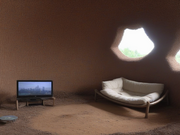
In the anthill’s living room.

Prompt snippets
Scene setting: a cozy, cavernous living room hollow in an ant hill within the brown modeling clay features walls textured with visible, hand-pressed imprints of "ant-made" construction. At the center, a large, circular rug made of spiraled, multi-colored wool yarn defines the space, surrounded by soft lounging pods sculpted from charcoal-grey felt. Within several of these felt pods in the mid-ground, multiple segmentally sculpted clay ant figures are nestled comfortably. Small, bioluminescent mushrooms crafted from translucent white clay and glowing neon-yellow wool sprouts provide a soft, ambient warmth.
Image style: hand-sculpted stop-motion animation still. Materials consist of matte polymer clay with visible slight thumbprints, blended with fuzzy needle-felted wool and soft roving fibers. Soft studio macro photography, shallow depth of field with a blurred background, high tactile contrast, and 24fps cinematic lighting.
Characters with an3