Pinyin final: "ai2"
/ai̯˧˥/
The Pinyin final "ai2" is used in the second half of Pinyin syllables. In MandarinBanana's mnemonic system, the second half of a Pinyin syllable is always represented by a location. You can visit the Pinyin index to see all Pinyin syllables from this mnemonic group, or to see all Pinyin syllables "ai2" can appear in.
Pronunciation Tips
The “Cheat Code”
Think of the vowel in “eye”, but keep it clean and quick, and put it in Tone 2 (rising: like asking “huh?”).
Mouth Mechanics (step-by-step)
- Start position (the “a-” part):
Open your mouth fairly wide, like you’re about to say “ah”.- Jaw: comfortably open (not strained).
- Lips: relaxed, not rounded.
- Tongue: low and flat-ish in the middle of the mouth.
- Glide to the “-i” part:
Without stopping the sound, slide toward a sound like the “ee” in “see,” but do not hold it.- Tongue: moves upward and slightly forward.
- Lips: stay mostly neutral (don’t pucker).
-
Keep it as one smooth vowel:
This is one syllable, not two. Avoid inserting a tiny break like “a…ee.” - Add Tone 2 (ai2):
While doing the vowel, let your pitch rise from mid to higher.- Imagine the intonation you use when you say “Really?” (rising).
English Approximation (2–3 words)
These are close, but you must keep them short and pure, and then add the rising tone.
-
“eye” — the whole vowel is similar to ai.
Match: the vowel sound in “eye.”
Adjust: keep the ending lighter; don’t drag out the “ee” part. -
“buy” — again, the vowel is similar.
Match: the vowel in “buy.”
Adjust: avoid making it too “rounded” or too slow. -
“Thai” — similar vowel quality for many speakers.
Match: the vowel in “Thai.”
Adjust: don’t turn it into two beats (“ta-hee”); keep it one glide.
If your English “eye” turns into something like “ah-yee” with a strong, long “ee,” shorten that final glide so it feels like one quick sweep.
Common Mistakes (English-speaker pitfalls)
- Breaking it into two syllables: saying something like “ah-ee” instead of one smooth ai.
- Overstretching the glide: holding the “ee” part too long, making it sound exaggerated or “sing-songy.”
- Wrong tone: Tone 2 must rise; don’t make it flat, and don’t drop it like a finishing statement.
- Adding extra color (American “drawl”): avoid turning it into a heavy, lazy diphthong; keep it clean and direct.
Practice Pairs (Pinyin vs. English approximation)
Pinyin (Tone 2) Closest English word What to copy from English What to change for Mandarin ai2 “eye” the vowel quality keep it shorter; add a clear rising pitch bai2 “buy” the -ai vowel don’t round; keep one smooth glide; add Tone 2 pai2 “pie” the vowel keep the glide quick; add Tone 2 (and note p is aspirated in Mandarin) mai2 “my” the vowel shorten the ending; add Tone 2 tai2 “Thai” the vowel keep it one syllable; add Tone 2 (and Mandarin t here is aspirated) lai2 “lie” the vowel avoid “la-yee”; add Tone 2 cai2 “tsai” (as in “tsa” start) the ai vowel keep the vowel pure; add Tone 2 hai2 “high” the vowel keep it clean; add Tone 2(English words are approximations to visualize the vowel; Mandarin accuracy comes from mouth shape + smooth glide + Tone 2.)
Comparisons & Caveats (similar sounds to watch out for)
-
ai vs. a (as in “a” in “father”):
ai is not a plain “ah.” It must glide upward toward an “ee”-like finish. If you stay on “ah,” it won’t sound like ai. -
ai vs. ei (as in “ei” like “эй”/“day”-type vowel):
ai starts more open (“ah”) and moves toward “ee.”
ei starts closer to an “eh” sound and glides differently. If you use the vowel in English “day” (without the “y”), you’re drifting toward ei, not ai. -
Tone matters more than you think (ai2):
The vowel ai can be correct, but if your pitch doesn’t rise, native listeners may hear a different word or a different tone category. -
With “u-” before it (huai2 / chuai2):
In syllables like huai2 and chuai2, there is a brief “w” glide before ai. You should feel a quick lip rounding/“w” movement first (like starting to say “w”), then immediately go into ai—still one syllable with Tone 2 rising.
Pinyin with ai2
Mnemonics for ai2
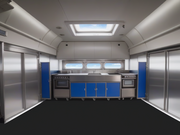
In the airplane’s kitchen.

Prompt snippets
Background: the narrow aircraft galley is a masterpiece of compact industrial design, characterized by brushed stainless-steel surfaces and rows of precision-latched storage canisters. Cool, recessed LED strip lighting glints off the metallic coffee carousels and the integrated warming ovens built into the bulkhead. High-tensile plastic meal carts are secured into tight floor-locks, their surfaces worn from frequent deployment through the cabin.
Image style: the style of the entire scene is that of a professional documentary photograph. Wide-angle or 35mm prime lens to capture high-contrast, unposed moments with naturalistic lighting, deep depth of field, and a sharp, grain-focused texture that prioritizes raw emotional realism over studio perfection.
Characters with ai2