Pinyin final: "o3"
/ɔ˧˩˧/
The Pinyin final "o3" is used in the second half of Pinyin syllables. In MandarinBanana's mnemonic system, the second half of a Pinyin syllable is always represented by a location. You can visit the Pinyin index to see all Pinyin syllables from this mnemonic group, or to see all Pinyin syllables "o3" can appear in.
Pronunciation Tips
The “Cheat Code”
Think of the “aw” in “law,” but say it with a clear dipping 3rd tone and don’t turn it into an “oh” glide.
Mouth Mechanics (step-by-step)
- Relax your jaw and let it drop a little (more open than for “oh”).
- Lips: make a small, gentle round shape—like you’re about to say “aw,” not a tight “oo.”
- Tongue: keep it low and relaxed, sitting flat in the mouth (don’t pull it back hard).
- Make one steady vowel: hold a single “aw”-like sound—do not slide toward “oh” or “oo.”
- Add the 3rd tone shape (˧˩˧): start mid, dip down, then rise again. Keep the mouth shape basically the same while the pitch changes.
English Approximation (2–3 words)
These are closest matches for many American English speakers; focus on the vowel part in bold.
- law (focus on the “aw”)
- call (focus on the vowel in “call”)
- thought (for speakers who pronounce it like “thawt”)
How to modify the English sound to match Mandarin “o”: - Say the “aw” in “law,” then freeze it—keep it as a single pure vowel. - Do not add the common English movement that turns it into something like “oh/owe.” - Then apply the 3rd tone dip-rise on that frozen vowel.
Common Mistakes (English speakers)
- Turning it into “oh” (like “go”): English “oh” usually glides; Mandarin o here should feel more like “aw” and more stable.
- Over-rounding the lips into “oo” (like “food”): the lips are rounded, but not tightly puckered.
- Changing the vowel while doing the tone: keep the vowel quality steady; only the pitch dips and rises.
- For -uo syllables (bo3, duo3, guo3, etc.): adding an extra syllable like “boo-oh” or “doo-oh.” It should be one syllable, not two.
Practice Pairs (visualizing the target)
Pinyin (3rd tone) Closest English cue What to copy o3 “aw” (as in law) Pure “aw” vowel + dip-rise tone wo3 “waw” (approx. like saying “wow” but with aw) Start with w, then a stable “aw” bo3 “baw” (as in “bah!”) Light b + “aw” (one syllable) duo3 “dwaw” (approx.) Quick d then “waw” in one beat guo3 “gwaw” (approx.) Back g then “waw” smoothly suo3 “swaw” (approx.) s then “waw,” keep it flowing cuo3 “ts + waw” (approx.) A crisp “ts” then “waw” (one syllable) huo3 “hwaw” (approx.) Breathier h then “waw,” no extra vowelNote: The English cues are approximations meant to guide your mouth shape. The key is the stable “aw”-like vowel plus the 3rd tone.
Comparisons & Caveats (similar sounds to watch out for)
A) o3 vs -uo3 (as in bo3, duo3, guo3…)
- o3 alone is a plain open “aw”-like vowel.
- In most syllables written with -uo (bo3, po3, mo3, fo…; duo3, tuo3, nuo3, luo3; guo3, kuo…; huo3; zuo3, cuo3, suo3), you typically hear a quick “w” element before the same “o” vowel: it’s like w + o, but still one syllable.
- Don’t separate it into two beats (“doo–oh”). Aim for one smooth unit: d(w)o.
B) o (this sound) vs ou (as in “ou” = like “oh” with a glide)
- ou has an obvious glide (it moves toward a “oo”-like ending).
- This o should feel more open and more “aw,” with little to no glide.
C) o vs e (the Mandarin “e” sound)
- Mandarin e is usually less rounded and often sounds more “uh/err”-like depending on context.
- This o is rounder and more “aw”-like.
D) Tone warning for 3rd tone in real speech
- In careful practice, do the full dip-rise.
- In faster conversation, 3rd tone is often shortened (it may sound more like a low dip). For textbook practice, keep the full shape first so your base pronunciation stays accurate.
Pinyin with o3
Mnemonics for o3
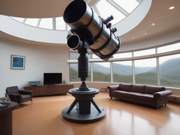
In the observatory’s living room.

Prompt snippets
Scene setting: the living room in the observatory blends scientific wonder with cozy comfort. A massive telescope dominates the center of the room, its polished metal frame aimed toward the wide, curved windows that open to a breathtaking view of the night sky. Around it, soft armchairs, a low coffee table stacked with star charts, and warm floor lamps create an inviting contrast to the gleaming equipment. Bookshelves lined with astronomy texts and a softly crackling fireplace give the space a lived-in warmth — a perfect balance between exploration and repose.
Image style: astrophotography.
Characters with o3