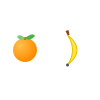
Pinyin initial: "ji"
/tɕi/
The Pinyin initial "ji" is used in the first half of Pinyin syllables. In MandarinBanana's mnemonic system, "ji" belongs to the group of Pinyin initials which are represented in mnemonics by women. You can visit the Pinyin index to see all Pinyin syllables from this mnemonic group, or to see all Pinyin syllables "ji" can appear in.
Pronunciation Tips
The “Cheat Code”
Think of “jee” as a very tight, smiley “j”—like the “j” in “jeep,” but with your tongue pushed higher and farther forward so it sounds lighter and more “hissy.”
Mouth Mechanics (step-by-step)
-
Start with a small smile.
Spread the lips slightly (like you’re about to say “ee” in see). This helps place everything forward. -
Teeth close-ish, not clenched.
Keep the teeth fairly close to each other. The sound is made with a narrow channel of air, not a wide “ah” mouth. -
Tongue tip down; tongue blade up.
Put the tip of your tongue behind your bottom front teeth (it can lightly touch them).
The front flat part of your tongue (just behind the tip) rises toward the front roof of your mouth. -
Aim the “pinch point” behind the tooth ridge.
The main contact/near-contact is just behind the bump behind your upper front teeth (the tooth ridge), but it feels slightly farther back and higher than an English “j.” -
Make it “squeezed,” then release.
Build a brief stoppage (like starting a “t”), then release into a soft hiss (like a very gentle “sh,” but brighter).
It should feel like “t” + “y” + “hissy” all fused into one smooth sound. -
Add the vowel, and keep it front.
In ji-, the following vowel is very front and tight (like an “ee”-type mouth). Keep the smile and the forward tongue position.
English Approximation (how to get close)
This sound does not match a single standard English consonant perfectly. Use these approximations and adjustments:
-
“jeep” — focus on the beginning “j” sound.
Adjustment: Make it lighter and more forward: keep a bigger “ee” smile, and don’t let it become a heavy, back-of-mouth “j.” -
“gee” (as in “gee whiz”) — focus on the “g/j”-like start depending on your accent.
Adjustment: Don’t make a hard “g.” You want an affricate feeling (brief stop + hiss) rather than a plain stop. -
“cheese” — focus on the “ch” part, but this is only a shape hint.
Adjustment: English “ch” is usually too “wide” and too strongly “sh.” Make it more narrow, more “ee,” more forward, and with less “sh” weight. -
A practical building trick: say “t” (very lightly) with the tongue forward, then slide immediately into “y” (yes) and hold a tiny hiss like soft “sh”. Blend it into one sound: (t + y + soft hiss).
Common Mistakes (what to avoid)
-
Don’t pronounce ji as English “jee” too heavily.
English “j” often sounds thicker and farther back. Mandarin j- should sound tighter, brighter, and more forward. -
Don’t turn it into “zh” (retroflex).
If your tongue curls back or the sound becomes dark and “dr”-like, you’ve drifted toward zh. -
Don’t turn it into “ch” with strong air.
Mandarin j is not strongly puffed with air. If you hear a big burst like English ch in church, soften it. -
Don’t insert an extra “y” syllable.
You want one smooth onset, not “jee-uh” or “juh-ee.”
Practice Pairs (visual sound mapping)
Pinyin (target) Closest English cue What to copy from English What to change to match Mandarin j- ji (as in ji1/ji2/ji3/ji4) jeep (start) the “j” release make it more forward, more narrow, keep a strong ee-smile jia ja (as in “jazz”, start) the initial “j” keep the tongue higher/front, don’t make a heavy English “j” jie J (letter name “jay,” start) the initial “j” gesture keep it tighter and more “ee”-like in the mouth, even before “-e” jiao jowl (start) the “j” start make the “j” brighter, not thick; keep the tongue tip down jiu juice (start) the “j” start make the onset lighter and more forward, avoid strong “ch/ts” feel(English cues are approximations; the goal is the Mandarin j mouth-shape and forward placement.)
Comparisons & caveats (how j- differs from similar Pinyin sounds)
j- vs zh-
- j- is front and “smiley”: tongue stays forward, tip down, sound is bright.
- zh- is pulled back: the tongue shape tends to feel backer/darker, sometimes with a slight curl-back sensation.
Quick check: If it starts to sound like an English “dr/jr” in drive/juror, you’re drifting toward zh.
j- vs q-
- Both are very forward and similar in tongue area.
- q- has a stronger burst of air (more “ch”-like).
- j- is softer in airflow (less puff).
Quick check: Put your hand in front of your mouth—q- should feel noticeably airier than j-.
j- vs x-
- j- has a brief stop + release feeling (a “catch” then hiss).
- x- is pure smooth friction (more like a continuous soft hiss from the start).
Quick check: If you can “hold” the sound without a click/release at the beginning, it’s closer to x-; if it has a clear start-release, it’s j-.
Important spelling caveat (helps pronunciation)
In Pinyin, j is essentially locked to front, high vowel territory (you’ll see it with i / ia / ie / iao / iu / ian / in / iang / ing, etc.). Keeping that front “ee” mouth posture is one of the easiest ways for English speakers to consistently produce a correct, bright j- across syllables like ji, jia, jie, jiao, jiu, jian, jin, jiang, jing.
Pinyin with ji
Mnemonics for ji
Ji is for Joan of Arc.


Prompt snippets
Joan of Arc is depicted as a young woman with strong, noble features and short, wavy brown hair framing her determined face. She wears gleaming medieval armor that reflects her courage and faith, every plate finely crafted and battle-worn. A radiant golden halo encircles her head, symbolizing divine inspiration and unshakable conviction.
Characters with ji