Pinyin initial: "g"
/k/
The Pinyin initial "g" is used in the first half of Pinyin syllables. In MandarinBanana's mnemonic system, "g" belongs to the group of Pinyin initials which are represented in mnemonics by men. You can visit the Pinyin index to see all Pinyin syllables from this mnemonic group, or to see all Pinyin syllables "g" can appear in.
Pronunciation Tips
The “Cheat Code”
Think of g as an unaspirated “k”: like the k in “sky,” not the k in “kite.”
Mouth Mechanics (step-by-step)
- Relax your lips (no rounding unless the vowel needs it later, like in gou).
- Raise the back of your tongue so it lightly seals against the soft back part of the roof of your mouth (the part you touch when you say English k).
- Build a small pressure behind that seal—gently, not forcefully.
- Release cleanly by dropping the back of the tongue.
- Key point: As you release, do not blow extra air. Your voice should move right into the vowel smoothly.
A good self-check: hold a thin strip of paper in front of your mouth. For Mandarin g, the paper should barely move.
English Approximation (how to get close)
Mandarin g does not match English “hard g” in go exactly. In Mandarin, this sound is voiceless (more like k) but unaspirated (little to no puff of air).
Use these English anchors:
- “sKy” — the k sound in sky is close because it’s not strongly puffed.
Match the k release; then immediately go into the vowel. - “sCan” — the c/k in scan is also relatively low-air.
Use that same gentle “k” feeling. - “aCt” — the c in act can be a good reminder of a tight, clean closure without a big breathy burst.
How to modify English “k” to reach Mandarin g:
Say “kite” but remove the breathy burst: make it feel closer to the k in “sky.” That “reduced-air k” is the Mandarin g start.
Common Mistakes (what to avoid)
- Mistake 1: Adding a big puff of air.
English k at the start of a word (like “kite”) is often very airy. Mandarin g is not. - Mistake 2: Using an English “g” (voiced) like “go.”
Mandarin g is typically not voiced; don’t “buzz” your throat at the start. - Mistake 3: Turning it into “kuh/ guh” with an extra little vowel.
Keep the release tight and immediate into the real vowel: ga, ge, gou… (no extra “uh” inserted).
Practice Pairs (visual + sound target)
These English words are approximations to help you aim your mouth and airflow.
Pinyin syllable (initial g) English approximation What to copy from English ga (e.g., ga1, ga4) sKy (start) The low-air k release (no big puff) ge (e.g., ge1, ge4) sCan (start) Same tight, low-air k start gai (e.g., gai1, gai4) sky → “kai” feeling The k release, then glide into “ai” gei (e.g., gei1, gei3) sKate (start) The k in “sk-” then move into “ei” gao (e.g., gao1, gao4) sk + “ow” (as in “cow”) The sk-type k, then “ao” glide gou (e.g., gou1, gou4) sCope (start) The low-air k start, then “ou” gan (e.g., gan1, gan4) scan (start) The sc- k-like closure + clean release gen (e.g., gen1, gen4) scan (start) + “en” Keep the start unpuffed; then “en” gang (e.g., gang1, gang4) sk + “ang” (like “song” ending) Low-air k start + nasal ending geng (e.g., geng1, geng4) sk + “ung” (loose) Low-air k start; keep ending nasalUse the table like this: say the English word without exaggerating air, then repeat the Pinyin syllable keeping the same low-air start.
Comparisons & Caveats (don’t confuse these)
g vs. k (most important contrast)
- g = unaspirated (little/no puff of air)
- k = aspirated (noticeable puff of air)
A quick test: put your hand in front of your mouth.
- k should feel like it “kicks” your hand with air.
- g should feel much calmer.
g vs. j / q / x (place of tongue)
- g is made with the back of the tongue (far back in the mouth).
- j/q/x are made more forward (front/middle tongue area).
If you feel the closure drifting forward, you may accidentally slide toward j/q/x territory.
**g is not English “g”
Even though Pinyin writes it as g, the Mandarin sound is closer to a gentle, unpuffed k than to the voiced English “g” in “go.”
Pinyin with g
Mnemonics for g
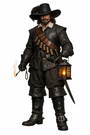
G is for Guy Fawkes.
Prompt snippets
Guy Fawkes is a tall, stern English conspirator with a rugged, soldierly build and a sharp, watchful expression. He features a prominent, upturned "handlebar" moustache and a neatly trimmed, pointed auburn goatee. His hair is dark and shoulder-length, partially tucked under a high-crowned, wide-brimmed black felt "cavalier" hat with a drooping brim that casts a deep shadow over his eyes. He is dressed in a dark charcoal double-breasted leather jerkin over a thick, cream-colored linen shirt with a modest ruffled collar. He wears heavy, thigh-high black leather riding boots with large silver buckles and thick woolen breeches. Slung across his chest is a wide leather bandolier holding small wooden containers of gunpowder, and he is often depicted holding a dimly glowing iron lantern and a slow-burning match-cord.
Characters with g