Pinyin initial: "tu"
/tʰu/
The Pinyin initial "tu" is used in the first half of Pinyin syllables. In MandarinBanana's mnemonic system, "tu" belongs to the group of Pinyin initials which are represented in mnemonics by animals. You can visit the Pinyin index to see all Pinyin syllables from this mnemonic group, or to see all Pinyin syllables "tu" can appear in.
Pronunciation Tips
The “Cheat Code”
Think of a clean, strongly “puffed” English T (as at the start of “top”) followed immediately by a Chinese u that sounds like “oo” in “food.”
Mouth Mechanics (step-by-step)
- Start with your tongue tip on the gum ridge: Put the tip of your tongue right behind your upper front teeth, on the little “bump” (the gum ridge).
- Seal the air briefly: Your tongue blocks the air completely for a moment (like an English t).
- Release with a clear puff: Let the tongue pop off the gum ridge quickly, creating a noticeable burst of air.
- If you hold your palm a few inches in front of your mouth, you should feel air.
- Go straight into the vowel: Immediately after the burst, move into the vowel of the syllable (u /uo /ui /uan /un /ong).
- Keep the tongue “forward” for the T, then relax: The consonant part is crisp and forward; don’t let it turn muddy or “d-like.”
- Lips depend on the following final:
- For tu: lips rounded like “oo.”
- For tuo / tun / tuan / tong: lips often start rounded and may shift slightly as the vowel changes.
- For tui: you’ll end with a “y-like” glide (as in “way”), but keep the initial t clean and aspirated.
English Approximation (2–3 words)
Because English and Mandarin don’t match perfectly, use these as “near targets”:
- “top” (the t at the beginning): The initial t is similar because it’s aspirated—you hear/feel a puff of air right after the t.
- “tool” (the too- part): The vowel in tu is close to the “oo” in “tool.” Aim for a steady, pure oo.
- “two” (the tw- feeling, for syllables like tuo, tuan, tun): Some tu- syllables naturally have a light w-like rounding as you go into the vowel (you can feel the lips rounding early), but keep it subtle and don’t insert an extra syllable.
How to modify your English sound to get closer: - Use the t from “top,” but make it cleaner (no extra “ts” noise). - Go into a purer oo (less relaxed than some English “oo” sounds). - Avoid turning it into “choo” (that’s a different Mandarin sound).
Common Mistakes (English speakers)
- Not enough puff of air: Mandarin t in tu- is a “puffed” t. If you make it too soft, it starts to resemble Mandarin d-.
- Turning it into “choo-/true-”: Don’t let the tongue pull back or add an English “ch/ts” quality.
- Adding an extra vowel before u: Avoid saying “tuh-oo” or “tee-oo.” It should be one smooth syllable: t + u.
- Overdoing the “w” in tuo/tuan/tun/tong: There can be natural lip-rounding, but don’t pronounce an obvious separate “tw” like in careful English “twelve.”
Practice Pairs (visualizing the sound)
These English words are approximations to help you “lock in” the mouth feel—your goal is the Mandarin syllable.
Pinyin (with tu- initial) English approximation What to copy from English tu “tool” Clean t start + oo vowel tuo “tour” (many accents) Rounded start; one smooth syllable (don’t add extra beats) tui “tway” (say “two” + “way” quickly) Fast glide toward an -ay feeling, but keep t crisp tuan “twang” (approx.) Early lip-rounding + moving into an a-like vowel, ending with n tun “took” (vowel differs) / “toon” (ending differs) Start with aspirated t; then aim for a more central un ending (Mandarin is not exactly either) tong “tongue” (start only) The t burst; then a rounded vowel ending in -ngComparisons & Caveats (similar sounds to watch)
tu- vs du-
- tu- is the puffed/aspirated one (strong air burst).
- du- is less puffed (more like a “soft t/d” to English ears).
Quick test: put your hand in front of your mouth—tu should blow air noticeably more than du.
tu- vs chu-
- chu- uses a different tongue shape and sounds more like English “ch” (with friction).
- tu- is a plain t release—quick and clean, no hissy friction.
tu- vs tsu- / cu-
- cu- (and related sounds) has a “ts” quality (like the end of “cats”), not a plain t.
- tu- must stay a simple t followed by the vowel—no added s sound.
Finals that commonly follow tu- (what changes, what doesn’t)
- The t part stays the same across: tu, tuo, tui, tuan, tun, tong.
- What changes is mainly the lip rounding and the vowel path:
- tu: steady oo
- tuo: rounded into a more open vowel (a “wo”-like feel)
- tui: rounded start then a quick glide toward an “ay”-like ending
- tuan / tun: rounded start + end with n
- tong: rounded vowel + end with ng (back-of-mouth nasal)
Pinyin with tu
Mnemonics for tu
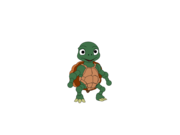
Tu is for Tommy Turtle.

Prompt snippets
Tommy Turtle is a compact, sturdy male Eastern Box Turtle with a high-domed, blackish-brown carapace (shell) adorned with radiant, bright yellow and orange starburst patterns. His most striking and gender-specific feature is his brilliant, fiery red eyes. His skin is dark brown, heavily scaled, and flecked with vivid orange spots on his thick, powerful neck and forelegs. The plastron (bottom shell) has a distinct central concavity (a deep inward curve) and a functional hinge that allows him to close his shell tightly. He has a slightly hooked upper beak and four sturdy, clawed toes on each hind foot, with his thick tail being longer and thicker at the base than a female's.
Characters with tu