Pinyin initial: "d"
/t/
The Pinyin initial "d" is used in the first half of Pinyin syllables. In MandarinBanana's mnemonic system, "d" belongs to the group of Pinyin initials which are represented in mnemonics by men. You can visit the Pinyin index to see all Pinyin syllables from this mnemonic group, or to see all Pinyin syllables "d" can appear in.
Pronunciation Tips
The “Cheat Code”
Think of “d” in Mandarin as an unaspirated “t”—like the t in “stop” (not the t in “top”).
Mouth Mechanics (Step-by-step)
- Relax your voice: Keep your throat “quiet.” Mandarin d is typically not voiced the way English d often is.
- Tongue position: Place the tip of your tongue on the ridge just behind your upper front teeth (the same spot you use for English t/d).
- Seal the airflow: Press lightly to make a complete closure so air cannot pass through.
- Release cleanly (no “puff”): Open the tongue closure quickly and neatly. The key is a small, tight release, not a breathy burst.
- Go straight into the vowel: Immediately continue into the final (a, e, ai, ao, ou, an, en, ang, eng, etc.) smoothly.
A good self-check: hold your palm a few inches in front of your mouth. On a correct Mandarin d, you should feel little to no burst of air.
English Approximation (How to get close)
Mandarin d is closest to an English t that comes after s, because that t is naturally said with minimal airflow.
Use these approximations: - “stop” — focus on the t in s-top (the sound right after the s). - “steam” — focus on the t in s-team. - “sting” — focus on the t in s-ting.
How it matches: - In these words, the t is made at the right tongue spot and it is not strongly aspirated (not breathy). That “no big puff” quality is what you want for Mandarin d.
If you only know English d as in “dog”: - Keep the tongue position of English d, but remove the voicing and remove the puff—you want a crisp, quiet release.
Common Mistakes (What English speakers do wrong)
- Adding too much air (aspiration): English speakers often pronounce Mandarin d like English t in “top,” which has a noticeable puff of air. Mandarin d should be tighter and less breathy.
- Voicing it like English “d”: Many learners make it sound like a strong English d (buzzing/voiced). Mandarin d is usually cleaner and less voiced.
- Overholding the stop: Some learners “clamp” too hard, causing a heavy, awkward sound. Aim for light contact and a quick release.
Practice Pairs (Pinyin ↔ English cue)
These English words are pronunciation cues, not translations. Focus on matching the consonant feel (a tight, low-air “t” sound) before the vowel.
Pinyin (with d) English cue (approx.) What to copy from English da “stop” (the t after s) + “ah” The t release after s, then open “ah” de “stub” (the t after s) (vowel is only a rough guide) The tight, no-puff t quality dai “stay” (the t after s) The t after s + glide into “ay” dao “stowel” (the t after s) The t after s + glide toward “ow” dou “stoke” (the t after s) The t after s + rounded “oh/ow” movement dan “stawn” (approx.) The t after s + end with n deng “stung” (approx.) The t after s + end with ngTip: For each row, whisper the English cue first (whispering reduces voicing), then say the Pinyin syllable while keeping the same “tight, low-air” onset.
Comparisons & Caveats (Similar Pinyin sounds)
d vs t (the most important contrast)
- Mandarin d = unaspirated (little/no puff of air)
- Mandarin t = aspirated (clear puff of air)
Quick test: - Put your palm near your mouth. - Say Mandarin da: you should feel very little air. - Say Mandarin ta: you should feel a stronger burst.
d vs English letter “d”
- English d is often strongly voiced (you can feel vibration in your throat).
- Mandarin d is typically less voiced and behaves more like a tight English t (especially the t in “stop”).
d vs z / zh / j (don’t move the tongue too far back)
- Mandarin d is made with the tongue tip at the front ridge behind the teeth.
- Sounds like zh are farther back with a different tongue shape.
- If your d starts sounding “retroflex” (curled-back) or “buzzier,” bring the tongue back to the front ridge and keep the release clean and tight.
Pinyin with d
Mnemonics for d
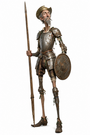
D is for Don Quixote.

Prompt snippets
Don Quixote is a tall, unnaturally gaunt and spindly Spanish knight in his 50s, with a long, narrow face and a prominent, hooked nose. He has a stringy, pointed grey beard and deep-set, wide eyes that burn with a fanatical, visionary intensity. His most iconic feature is his "helmet"—the shining brass Mambrino's helmet, which is actually a shallow, notched barber's basin worn upside down. He is clad in a rust-potted, mismatched suit of 15th-century plate armor that is clearly too small for his lanky limbs, held together by bits of green ribbon and leather cord. He grips a long, splintered wooden lance and a battered round buckler shield.
Characters with d