Pinyin initial: "p"
The Pinyin initial "p" is used in the first half of Pinyin syllables. In MandarinBanana's mnemonic system, "p" belongs to the group of Pinyin initials which are represented in mnemonics by men. You can visit the Pinyin index to see all Pinyin syllables from this mnemonic group, or to see all Pinyin syllables "p" can appear in.
Pronunciation Tips
The “Cheat Code”
Think of the p in “pie” when you say it with a clear puff of air—like you’re trying to lightly fog a tiny spot on a window.
Mouth Mechanics (step-by-step)
- Close your lips firmly (both lips together), as if you’re about to say an English p.
- Build a little air pressure behind your lips while keeping the tongue relaxed (the tongue does not “make” this sound).
- Release the lips suddenly to start the syllable.
- Add a noticeable burst of air right after the release. (A quick “whoosh” of breath is the key feature.)
- Immediately move into the vowel that follows (a, o, ai, ei, ao, ou, an, en, ang, eng) without inserting an extra vowel like “uh.”
Quick self-check: Hold your hand or a thin piece of paper about 2–3 inches in front of your mouth. When you say Chinese p-, you should feel/see a stronger burst than in English “sp-” words.
English Approximation (how to get close)
English has a similar sound, but the amount of air is the issue.
- “pie” — The p at the beginning is close. Use the very start of p in pie, but make sure the burst of air is crisp and obvious.
- “pay” — The p in pay is similar; again, focus on the puff of air right as the lips open.
- “pole” — The p in pole is similar; keep it clean and don’t soften it into a “b.”
Important adjustment for many learners:
If your p sounds too weak, exaggerate the breathy “pop” at first. If it sounds like b, you’re not releasing enough air (or you’re voicing it).
Common Mistakes (English-speaker patterns to avoid)
- Mistake: Saying it like English “b.”
Chinese p- is a “breathy pop.” If you make it heavy/voiced like b, listeners may hear b- instead. - Mistake: Adding an extra vowel (“puh-”).
Don’t say puh-a for pa. It should be one smooth start: p → a. - Mistake: Too little air (especially after “s” habits).
In English, p in “spin” is weak. If you copy that “spin p,” your Chinese p- may sound wrong.
Practice Pairs (visualizing the sound)
These English words are approximations to help you aim your mouth and airflow. Match the initial p.
Pinyin syllable English approximation What to copy pa pa in “pa-pa” The initial p burst, then open to a po po in “po-lar” The initial p burst, then rounded lips for “o” pai pi in “pie” Strong initial p, then glide toward “ai” pei pay Strong initial p, then “ay”-like vowel pao pow in “pow!” Strong initial p, then “ow” glide pou po in “po-et” (start) Strong initial p, then “oh/ou” glide pan pan Strong initial p, then end with n pen pen Strong initial p, then a “uh/eh”-like vowel, end with n pang “pong” (but more open “a”) Strong p, then open vowel, end with “ng” peng “pung” (approx.) Strong p, central vowel, end with “ng”Reminder: The goal of the table is the initial p. The vowels/finals in Mandarin are not always identical to English.
Comparisons & Caveats
p vs b
In Mandarin, p- is the strong, airy version; b- is the less airy version. Many English speakers expect “b” to be voiced and “p” to be voiceless, but the practical listening difference in Mandarin is mainly how much air follows the release. If you don’t hear/feel that burst, you’re drifting toward b-.
Pinyin with p
Mnemonics for p
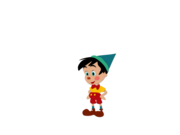
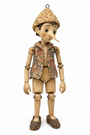
P is for Pinocchio.
Prompt snippets
Pinocchio is a small, charming wooden puppet with a playful, naive face and bright, wide-set blue eyes painted onto his glossy surface. He is constructed from finely jointed pale wood, with visible hinges at his elbows, knees, and hips, and small round rivets in his shoulders. His most defining feature is his elongated, slender wooden nose which protrudes significantly (though currently at a medium length). He wears a cheerful outfit: a pair of bright red, oversized shorts held up by yellow suspenders, a crisp white collared shirt, and a large, floppy sky-blue bow tie. His head is topped with a jaunty, small conical yellow felt hat with a single, blue-striped feather and a blue ribbon band. He has carved wooden hair painted black and wears little brown, scuffed wooden shoes. His movements seem stiff yet animated.
Marionette design reference: render the marionette as a slender, articulated, short, young adult male marionette roughly carved from raw, unstained pine wood, showing visible tool marks, slight imperfections, and a prominent wood grain texture. He has simplistic, painted facial features with wide, dark eyes and a distinctly long, sharply pointed nose that looks freshly carved. He is dressed in a little hat made of leavened bread crumbs, a jacket of flowered paper in muted reds and blues, and a pair of tiny wooden shoes made of bark. Visible, functional peg-and-socket joints are at the elbows, knees, and shoulders, and there is a small metal ring attached to the very top of his head.