Pinyin initial: "shu"
/ʂu/
The Pinyin initial "shu" is used in the first half of Pinyin syllables. In MandarinBanana's mnemonic system, "shu" belongs to the group of Pinyin initials which are represented in mnemonics by animals. You can visit the Pinyin index to see all Pinyin syllables from this mnemonic group, or to see all Pinyin syllables "shu" can appear in.
Pronunciation Tips
The “Cheat Code”
Think of “sh” in shoe, but make it darker and farther back in the mouth, with the tongue curled slightly up—then go straight into the “u/oo” vowel.
Mouth Mechanics (step-by-step)
- Start relaxed: Jaw slightly open, face relaxed.
- Tongue position (the key):
- Pull the tongue slightly back.
- Curl the tip of the tongue gently upward (not touching the teeth).
- Aim the airflow toward the roof of the mouth just behind the ridge you feel behind your top front teeth (but the tongue is farther back than English “sh”).
- Teeth: Keep the teeth close but not clenched. There should be a narrow passage for the air.
- Lips: Round the lips a little (as if preparing to say “oo”). This rounding helps the “shu-” quality.
- Make the sound: Let air hiss steadily to produce the sh-like friction, then immediately glide into the final:
- shu- goes into an “oo”-type sound.
- In many “shu-” syllables (like shua, shuo, shuai, shui, shuan, shun, shuang), you’ll feel a quick “w”-like glide as you move from the initial into the vowel.
Goal feel: a retro-style “sh” (tongue slightly curled back) + quick glide into the vowel, with no extra stop or “t” sound.
English Approximation (what to copy and how to modify)
Because the exact “shu-” initial is not a perfect match to any single English sound, use English “sh” as your base and modify it:
- “shoe” — use the “sh-” part
- Copy the “sh” sound, but pull it farther back and curl the tongue tip slightly up.
- “shook” — use the “sh-” part
- This can help you keep the sound darker (less “bright” and forward).
- “rush you” (said quickly) — use the “sh y-” blend
- If you say “rush you” fast, you may briefly create a more retracted, heavier “sh”. Then adjust by curling the tongue tip slightly upward and rounding the lips into “oo.”
How to modify English “sh” to get close:
- English “sh” is usually too front-of-mouth. To fix it, pull the tongue back and let the air hit a point farther back on the roof of the mouth.
- Add light lip rounding early, as if “oo” is coming next.
Common Mistakes (English-speaker traps)
- Too English “sh” (too forward): If it sounds like ordinary “sh” with the tongue pushing toward the front teeth, it will not sound like Mandarin sh-.
- Accidentally saying “s” or “sw”: “shu-” is not “soo” and not “swoo.” Keep it clearly sh-like, not “s.”
- Adding a “t” or “ch” bite: Don’t let it turn into “choo.” It should be a smooth hiss, not a stop + hiss.
- Forgetting lip rounding: Especially in syllables like shu, shuo, shun, lack of rounding can make the sound drift toward something like “she-” instead of “shu-.”
Practice Pairs (visualize the target sound)
These English words are approximations to help you “aim” your mouth. The left side is the Mandarin target; the right side is only a guide for the starting feel.
Pinyin syllable (target) English approximation (guide) What to copy shu shoe Start with “sh,” then go into “oo”; make the “sh” farther back and darker shua shwa- (as in “schwa,” but with sh) A quick “sh” + “w” glide into “ah” shuo shwo- “sh” then a clear w-glide into an “oh”-like sound shuai shwye (like “sh” + “why”) “sh” + w glide + “ai/eye” shui shway “sh” + w glide + “ay” shuan shwan “sh” + w glide + “an,” ending with n shun shwun “sh” + w glide + relaxed “uh,” ending with n shuang shwang “sh” + w glide + “ang,” ending with the back nasal soundTip for tones: Keep the initial “sh-” exactly the same across tones; only your pitch contour changes.
Comparisons and caveats (similar Pinyin sounds to watch)
A) sh- vs x-
- sh- (as in shu-) is darker, heavier, farther back, with the tongue tip slightly curled up/back.
- x- is lighter and more “hissy,” made farther forward with the tongue more flat and close to the roof of the mouth.
- If your “shu” starts sounding like “syu/xyu”, you are likely drifting toward x-.
B) sh- vs s-
- s- is a straight “s” (front-of-mouth), with a sharper, thinner hiss.
- sh- should sound rounded and deeper, not like “see/soo.”
C) sh- vs zh- / ch-
- zh- and ch- begin with a brief “stop” feeling (like a tiny “d/t” before the hiss), while sh- is continuous airflow from the start.
- If you hear yourself making something like “j/zh + oo” or “ch + oo,” you’re likely adding that stop. For sh-, don’t “tap” into it—just start hissing smoothly.
D) “shu-” syllables often include a “w” glide
In shua, shuo, shuai, shui, shuan, shun, shuang, there is typically a quick rounded glide after the initial—your mouth moves toward w/oo-shape immediately. If you pronounce them without that glide, they may sound unnatural or like a different syllable.
E) Keep the initial steady across the set
Whether you say shu, shua, shuo, shuai, shui, shuan, shun, shuang, the initial is the same “sh-” mouth position—only the vowel movement changes right after it.
Pinyin with shu
Mnemonics for shu
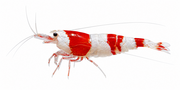
Shu is for Sheldon Shrimp.

Prompt snippets
Sheldon Shrimp is a delicate, translucent male Red Crystal Shrimp with a slender, segmented body characterized by stark, alternating bands of opaque snow-white and vivid scarlet-red. His shell has a glossy, glass-like finish, and his rostrum (the pointed "nose") is sharp and clear. He features long, thread-like white antennae that sweep back past his tail, and his small, bulbous eyes are a solid, glossy black. His walking legs are fine and translucent with a slight reddish tint, and his tail fan is wide and segmented, mirroring the red-and-white banding of his torso.
Characters with shu