Pinyin initial: "li"
/li/
The Pinyin initial "li" is used in the first half of Pinyin syllables. In MandarinBanana's mnemonic system, "li" belongs to the group of Pinyin initials which are represented in mnemonics by women. You can visit the Pinyin index to see all Pinyin syllables from this mnemonic group, or to see all Pinyin syllables "li" can appear in.
Pronunciation Tips
The “Cheat Code”
Think of the L in “leaf”, but make it cleaner and lighter, with the tongue touching the gum ridge just behind the top front teeth.
Mouth Mechanics (step-by-step)
- Relax your lips (no rounding, no “oo” shape unless the vowel later requires it).
- Put the tip of your tongue on the gum ridge right behind your upper front teeth (the bumpy ledge you feel if you run your tongue upward from your teeth).
- Keep the tongue tip firmly touching there, but don’t press hard.
- Let the air flow smoothly along the sides of the tongue (this is what makes it an “L” sound).
- Voice ON: your throat should be vibrating (it’s not whispered).
- Release directly into the final (vowel sound).
- For syllables like lia-, lie-, liao-, liu-, lian-, liang-, your tongue will quickly glide into a “y” shape right after the L (you’ll feel the middle/front of the tongue lift slightly as you move into the vowel).
English Approximation (2–3 words)
These English words contain a similar L sound; focus only on the L part:
- “leaf” — the L at the beginning is close. Aim for that clear, front L.
- “lee” — the L at the beginning is a good match for li-; keep it light.
- “link” — the L at the beginning is close; start with that L, then move into the rest of the syllable.
Important adjustment for accuracy:
In many English accents, L can become “dark” (especially at the end of words, like “ball”). For Mandarin l-, use a clear L: tongue tip forward on the gum ridge, and no heavy “uh” coloring in the back of the mouth.
Common Mistakes (what English speakers usually do wrong)
- Using a “dark L” (like the L in “ball”): this adds a back-of-tongue heaviness that Mandarin l- does not want.
- Turning l- into r- (especially before i): don’t curl the tongue or pull it backward.
- Over-tensing the tongue: the contact is firm but not stiff; keep the sound smooth.
- For li-: accidentally saying something like “lyee” with an extra, strong y glide. The glide can exist in some syllables (like liao, liu), but li itself should not feel like two separate sounds in English (“l + y + ee”). It’s one clean syllable.
Practice Pairs (Pinyin vs. English approximation)
Pinyin syllable (example) English approximation What to copy from English li (li2 / li3 / li4 / li5) “lee” Copy the initial L (clear front L), then the long ee quality lin (lin1–lin4) “link” (without the final k) Copy the L + short i feel; end with n ling (ling1–ling4) “ling” (as in “linguistics”) Copy the L and the ng ending (back nasal) lian (lian2–lian4) “Lee + en” (blended) Start with L, then glide quickly toward a “y” feel before -en/-an liang (liang2–liang4) “Lee + ahng” (blended) Clear L, then a quick y-glide into -ang with ng liao (liao1–liao4) “Lee + ow” (blended) Clear L, quick y-glide, then ow-like ending liu (liu1–liu4) “Lee + yo” (very tight blend) Clear L, quick y-glide, then a smooth -ou/-o style ending lie (lie1–lie5) “Lee + eh” (blended) Clear L, quick y-glide into ehNote: The English items are approximations meant to guide the starting L and the overall mouth feel. Mandarin syllables are more tightly blended than English two-word sequences.
Comparisons, similar Pinyin sounds, and caveats to watch out for
A) l- vs. r- (biggest confusion for English speakers)
- Mandarin l-: tongue tip touches the gum ridge; air flows along the sides of the tongue; sound is clear.
- Mandarin r-: tongue does not make the same clean contact; it sounds more “buzzed/retroflex” and is produced farther back.
Shortcut: If your tongue is curling back like American English r, you are not making l-.
B) l- vs. n- (another common mix-up)
- Both are made near the front of the mouth, but:
- l-: air flows around the tongue sides (you can keep voicing and feel openness).
- n-: air goes through the nose (you feel vibration in the nose; the mouth airflow is blocked).
Test: Hold your nose. If the sound collapses, you were drifting toward n-.
C) Why li- feels “tight” and why lia-/lie-/liao-/liu-/lian-/liang- often include a “y”-like glide
Many syllables after l- show a brief y-like transition (for example, liao, liu, lian, liang, lie). This means:
- li- itself is L + a very front “ee”-type vowel.
- In lia-, lie-, liao-, liu-, lian-, liang-, the mouth often moves from L into a front, raised tongue position before opening into the rest of the vowel.
Practical tip: Keep the L contact forward, then let the tongue glide smoothly—don’t insert an extra syllable.
D) “Clear L only” rule
Use the front (clear) L in all positions. Avoid English-style “dark L” coloring, especially if you tend to speak with a strong back-of-tongue L. A clean, forward L keeps li-, lian-, liang-, ling- sounding crisp and Mandarin-like.
Pinyin with li
Mnemonics for li
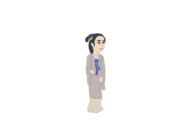
Li is for Li Qingzhao, writer and poet of the Song Dynasty.

Prompt snippets
Li Qingzhao is depicted as an elderly, elegant Song-dynasty female poet with a slender build, oval face, and delicate, refined features. She has smooth, fair skin; long, straight gray hair typically arranged in a simple, graceful bun; and thin, arched eyebrows over calm, perceptive eyes. Her clothing is a flowing Song-style hanfu in soft, muted colors such as pale green or light ivory, with wide sleeves and subtle embroidered patterns that reflect scholarly refinement.
Characters with li