Pinyin initial: "lü"
/ly/
The Pinyin initial "lü" is used in the first half of Pinyin syllables. In MandarinBanana's mnemonic system, "lü" belongs to the group of Pinyin initials which are represented in mnemonics by deities. You can visit the Pinyin index to see all Pinyin syllables from this mnemonic group, or to see all Pinyin syllables "lü" can appear in.
Pronunciation Tips
The “Cheat Code”
Say an English “L”, then immediately make a tight “ee” smile while rounding your lips as if whistling—this gives you lü.
Mouth Mechanics (step-by-step)
Goal: a clear L + a front “ee”-like vowel said with rounded lips (the special “ü” sound).
- Start with L (the same as English “l” in “leaf”).
- Put the tip of your tongue gently against the bumpy ridge just behind your top front teeth.
- Let air flow around the sides of your tongue (don’t block the air).
- Release the tongue tip smoothly.
- The tongue tip comes off that ridge lightly—no extra “d” sound.
- Immediately shape your tongue for “ee” (like “see”).
- The front of your tongue is high and forward, as if you’re saying “ee.”
- Your jaw is fairly relaxed—not wide open.
- While keeping the “ee” tongue position, round your lips.
- Keep the corners of the mouth slightly “smiling” (ee-position), but push the lips forward and round (like a small “oo” shape).
- This combination—ee-tongue + oo-lips—is the key to ü.
- Maintain steady voice.
- This syllable is voiced throughout; it should feel smooth and connected: l + ü → lü.
English Approximation (how to get close)
English does not have the exact ü vowel, so you must build it.
Closest “building blocks”
- “L” in “leaf / let / lull”
- Use the initial L sound.
- “ee” in “see” → then add lip rounding
- Say “see” and freeze your tongue in the ee position.
- Now, without moving your tongue backward, round your lips as if you’re about to say “oo.”
- That rounded “ee” is the closest English-speaker path to ü.
Helpful near-examples from names/borrowed words (if you know them)
- “ew” in some pronunciations of “few” / “cute” (in “yoo” accents) can resemble the rounded-front feeling, but it often includes an extra “y” glide or becomes too “oo”-like. Use it only as a hint, not a final target.
Common Mistakes (English speakers)
- Turning ü into “oo” (lü → loo)
- If your tongue pulls back and your lips round, you get oo.
- Fix: keep the tongue forward like “ee”.
- Turning ü into plain “ee” (lü → lee)
- If you forget lip rounding, it becomes ee.
- Fix: keep the lips rounded and slightly forward.
- Adding an extra vowel after L (lü → luh-yoo or lee-yoo)
- English speakers may insert a glide or extra syllable.
- Fix: make it one clean vowel after L: lü, not lü-uh.
- Over-pressing the tongue for L
- If you press too hard, it can sound tense or “clunky.”
- Fix: touch lightly and release smoothly.
Practice Pairs (visual sound anchors)
Pinyin (target) English “anchor” (approx.) What matches What to change to reach Pinyin lü2 “Lee” The L and the front tongue position Keep “Lee” tongue, round lips forward to make ü; use rising tone lü3 “Lee” The L onset Same as above: round lips while keeping tongue forward; use dipping tone lü4 “Lee!” (as a sharp call) The quick, clear start Keep the vowel as rounded “ee” (ü), not plain “ee”; use falling tone lüe4 “Lee + ‘eh’ ” (very fast) The idea of moving toward an “eh” quality Keep ü at the start, then glide to -e smoothly; don’t insert extra syllables; use falling toneNote: The English anchors are only to help you locate the mouth shape; the real target is L + ü (and for lüe, ü → e).
Comparisons & Caveats (similar Pinyin sounds)
lü (lü) vs. lu (lu)
- lu uses u (like a back “oo” vowel). Your tongue pulls back.
- lü uses ü (front tongue like “ee” with rounded lips). Your tongue stays forward.
Quick check:
- If it feels like “oo”, you’re in lu territory.
- If it feels like “ee” in the front but your lips are rounded, you’re closer to lü.
lüe (lɥe-) vs. lüe said as two parts
- lüe should be a single, smooth syllable: start with ü-shape and glide into e quickly.
- Common error: saying “lü-eh” as if two separate vowels. Keep it connected.
lü vs. li
- li is L + i (plain “ee”-like vowel), no lip rounding.
- lü requires lip rounding while keeping the tongue as forward as li.
Quick check: look in a mirror: li has relaxed/spread lips; lü has noticeably rounded lips.
Spelling caveat: ü sometimes appears without the dots
In standard Pinyin, ü keeps the dots after l (so you see lü, lüe). The dots are omitted for qu xu yu because those are always pronounced as -ü, never as -u.
Pinyin with lü
Mnemonics for lü
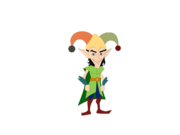
Lü is for Loki.

Prompt snippets
Loki is a lean, lithe Norse god with a sharp, angular face and a mischievous, asymmetrical smile. He has slicked-back, shoulder-length hair the color of charred embers (dark reddish-black) and piercing, fluid emerald-green eyes that seem to shift in hue. He is dressed in a complex layer of deep forest-green silk and supple black leather armor, accented with intricate bronze filigree in the shape of intertwining serpents. A heavy, tattered cloak of mottled grey wolf fur is fastened at his shoulder by a circular gold brooch. Most distinctively, he wears a slim bronze circlet with two long, elegant curving horns that sweep backward.
Characters with lü