Pinyin final: "ei5"
/ei̯/
The Pinyin final "ei5" is used in the second half of Pinyin syllables. In MandarinBanana's mnemonic system, the second half of a Pinyin syllable is always represented by a location. You can visit the Pinyin index to see all Pinyin syllables from this mnemonic group, or to see all Pinyin syllables "ei5" can appear in.
Pronunciation Tips
Pinyin Final: ei5
The “Cheat Code”
Think of the vowel in “say”—but make it clean and quick, gliding from “eh” to a short “ee” without turning it into “ay-uh.”
Mouth Mechanics (step-by-step)
- Start with a relaxed “eh” shape: jaw slightly open, lips relaxed (not rounded), tongue forward and comfortably flat.
- Aim the sound forward: you should feel the resonance toward the front of the mouth, not deep in the throat.
- Glide upward smoothly: as you continue the sound, raise the middle/front of your tongue toward a high “ee”-like position.
- Keep the lips mostly still: don’t round them; at most, they may tighten slightly, but they should not form an “oo” shape.
- End lightly and quickly: the second part (“-i”) is short and not stressed—it’s a glide, not a separate syllable.
English Approximation (what to listen for)
These English words are close in vowel quality, but you must adjust them slightly to match Mandarin.
- “say” — use the vowel in “say.”
Adjustment: In many English accents, “say” ends with a noticeable off-glide that can sound like “ay-uh.” For Mandarin ei, keep the glide tight and clean, with no extra “uh” at the end. - “day” — use the vowel in “day.”
Adjustment: Don’t let it widen into “dai-yuh.” Keep it one smooth glide. - “eight” — use the vowel in “eight.”
Adjustment: Don’t drag it out; Mandarin ei is often shorter and more focused than an emphasized English “eight.”
What part matches? The matching part is the main vowel—the “ay” sound—especially the front, “eh → ee” movement.
Common Mistakes (English-speaker pitfalls)
- Adding an extra “uh” at the end: English “say” can become “sei-yuh.” Mandarin ei should not end with a separate “uh” sound.
- Making it too long and dramatic: Mandarin ei is usually compact—a quick, neat glide.
- Turning it into “eye” (ai): Don’t drop the jaw too far or start with “ah.” ei starts closer to “eh,” not “ah.”
- Rounding the lips: Keep lips neutral; rounding makes it drift toward other vowels.
Practice Pairs (visualizing the target sound)
Pinyin (with ei5) English approximation What to copy (exactly) bei5 “bay” Copy the “bay” vowel, but end cleanly (no “bay-uh”). lei5 “lay” Copy the “lay” vowel, keep lips relaxed and the glide short. bei5 “bake” (first vowel only) Copy the “ba-” vowel in “bake” (the “ay”), not the “k.”(These English words are approximations; your goal is the smooth “eh → ee” glide.)
Comparisons & caveats (similar sounds to watch out for)
- ei vs. ai:
- ei starts closer to “eh” and glides upward (“eh → ee”).
- ai starts more open, closer to “ah” (“ah → ee”).
Tip: If your jaw opens wide at the start, you’re drifting toward ai, not ei.
- ei vs. e (single vowel):
- ei is a gliding sound (two-part movement).
- e is more steady (no strong glide).
Tip: For ei, you must move the tongue upward slightly near the end.
- ei vs. en / eng endings:
- ei ends with a vowel glide (no nasal sound).
- en/eng end with nasal resonance.
Tip: If air strongly resonates in your nose at the end, you’ve accidentally nasalized it—pull it back to a clean vowel glide.
- Tone note for “5”: The “5” here indicates a neutral/unstressed tone in this system. Keep the syllable light and quick, without strong pitch movement.
Pinyin with ei5
Mnemonics for ei5
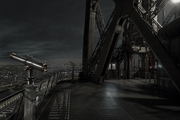
On the Eiffel Tower’s roof.

Prompt snippets
Scene setting: the summit of the Eiffel Tower is a breathtaking open-air observation deck where the intricate, crisscrossing lattice of rusted-iron girders meets the vast, panoramic expanse of the Parisian horizon. The floor is composed of durable, dark-grey industrial grating, through which glimpses of the city’s distant streets and the winding Seine are visible far below. Elegant brass-rimmed telescopes are bolted to the perimeter, their polished surfaces reflecting the golden hues of a setting sun that bathes the entire structure in a warm, amber glow.
Image style: render this scene with an oppressive industrial noir atmosphere, utilizing deep shadows and harsh, cold monochromatic floodlighting. Every element, from rusted metal textures to worn concrete surfaces, must be depicted with the clinical, hyper-realistic detail and static precision characteristic of New Objectivity. The resulting composition must strip away sentiment, presenting a detached, gritty, and structurally monumental reality.
Characters with ei5