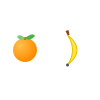
Pinyin final: "a5"
/a/
The Pinyin final "a5" is used in the second half of Pinyin syllables. In MandarinBanana's mnemonic system, the second half of a Pinyin syllable is always represented by a location. You can visit the Pinyin index to see all Pinyin syllables from this mnemonic group, or to see all Pinyin syllables "a5" can appear in.
Pronunciation Tips
The “Cheat Code”
Think of the “a” in “father”—a wide, open, steady “ah” sound.
Mouth Mechanics (Step-by-step)
- Relax your jaw and drop it so your mouth is quite open (as if the doctor says “Say ahh”).
- Keep your lips neutral: not rounded like “oo,” not spread like “ee.” Just relaxed.
- Put your tongue low and flat in the bottom of your mouth. The tongue tip can rest lightly behind the lower front teeth, but it shouldn’t press hard.
- Aim the sound straight out of the open mouth. Don’t “shape” it with lip rounding or tongue bunching.
- Hold it steady and clean: a single pure vowel, not a slide into another vowel.
English Approximation
These English examples are close because they use a wide, open “ah”-like vowel:
- “father” — the first vowel sound (“fa-”) is the closest match.
- “spa” — the vowel in “spa” is very similar; keep it plain and open.
- “calm” — the vowel in “calm” can be close if you don’t round your lips.
If your accent makes these sound different (some English accents change the vowel), the target is still: an open mouth “ah” with neutral lips and a low tongue, not “uh,” not “aw,” and not “ay.”
Common Mistakes (English-speaker pitfalls)
- Turning it into “uh” (like the “u” in “cup”). This happens when the jaw doesn’t open enough or the tongue rises too much.
- Rounding into “aw” (like “law”). Keep lips neutral, not rounded.
- Adding a glide like “ay-uh” or “a-eh.” This final should be one pure vowel, not a vowel sequence.
- Over-tensing the mouth. This sound is big and relaxed, not tight.
Practice Pairs (Pinyin vs. English approximation)
Pinyin (a5 family) Approx. English cue What to copy from English a5 “spa” the open “ah” vowel ba5 “spa” (focus on the vowel) keep the same “ah” after the consonant da5 “taco” (first “a” in “ta-”) the open “ah” right after t/d-like tongue contact la5 “la-la” (singing “la”) the clear open “ah” after l ya5 “yacht” (start) the y + ah feeling (“ya…”) wa5 “watch” (start, but don’t round too much) start with w, then open to ah ma5 “mama” (first “ma”) the simple “mah” syllable na5 “nana” (first “na”) the simple “nah” syllableNote: The English words are only anchors. The goal is always the same vowel: open, relaxed “ah.”
Comparisons / Caveats (similar pinyin sounds to watch)
- a5 vs. e-like sounds: Don’t let a5 drift toward an “uh/er” quality. If you hear yourself approaching the vowel in “but” or “her,” open the jaw more and lower the tongue.
- a5 vs. ai: ai has a noticeable glide (it moves toward an “ee”-like position). a5 should not move—keep it steady.
- a5 vs. ao: ao usually includes lip rounding and a glide toward an “oo”-like shape. For a5, keep lips neutral and the sound straight “ah.”
- a5 after different initials (ba5, da5, la5, etc.): The consonant changes, but the vowel stays exactly the same. The most common issue is unconsciously changing the vowel depending on the consonant; don’t. Lock in one consistent “ah” target.
Pinyin with a5
Mnemonics for a5
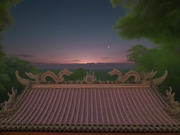
On the ashram’s roof.

Prompt snippets
Scene setting and image style: a 90s analog color photograph, featuring the characteristic light leaks and warm, grainy texture of vintage film, captures the flat, expansive terracotta-tiled roof of the ashram. Large, circular sun-dials and hand-painted astrological charts are etched directly into the weathered stone floor, marking the space as a site for celestial meditation. Long hemp ropes are strung across the parapets, draped with rows of drying saffron and ochre monk robes that flutter in the heavy, humid breeze. In the center, a small, elevated cupola houses a weathered bronze bell and a collection of brass oil lamps, their soot-darkened edges reflecting the golden hour light. The image's soft focus and saturated blues of the vast sky overhead emphasize the quiet, elevated sanctuary high above the bustling courtyard.
Characters with a5