Pinyin initial: "pi"
/pʰi/
The Pinyin initial "pi" is used in the first half of Pinyin syllables. In MandarinBanana's mnemonic system, "pi" belongs to the group of Pinyin initials which are represented in mnemonics by women. You can visit the Pinyin index to see all Pinyin syllables from this mnemonic group, or to see all Pinyin syllables "pi" can appear in.
Pronunciation Tips
The “Cheat Code”
Think of the P in “peel” said with a clear, noticeable puff of air, then go straight into a high, tight “ee” vowel.
Mouth Mechanics (step-by-step)
- Set your lips: Bring your lips together gently, like you’re about to say English P.
- Build pressure: Keep the lips closed for a brief moment while air builds up behind them.
- Release with a puff: Open the lips quickly so a small burst of air comes out (you should be able to feel it on your hand if you hold it in front of your mouth).
- Go immediately to “ee”: Right after the burst, move into a clean, tense “ee” sound:
- Corners of the mouth slightly spread (a small “smile” shape).
- Tongue high and forward inside the mouth (close to the roof of the mouth, but not touching).
- Keep it clean and light: The start is crisp (the puff), but the rest of the syllable is smooth—don’t drag out the “P.”
What you are aiming for in syllables like pi-, pin-, ping-, and piao-/pian-/pie- is the same initial: a strongly aspirated “p” at the very beginning, followed by the appropriate vowel movement.
English Approximation (2–3 words + what matches)
- “peel” — The P at the start is close, especially if you pronounce it clearly at the beginning of a phrase (that initial puff of air is what you want).
- “pea” — The P onset plus the “ee” vowel is a good match; focus on making the P extra airy.
- “pin” — The P onset is useful, but in Mandarin pin must keep the noticeable puff and the vowel should stay pure and forward.
If your English P feels weak, practice saying “pea” as if you’re trying to gently fog up a tiny spot on a window right at the start—only on the P release, not on the vowel.
Common Mistakes (English-speaker patterns)
- Not enough air (too “soft”): Many learners use a “plain” English P that doesn’t release enough air. Mandarin p- needs a clear puff at the moment the lips open.
- Accidentally turning it into “b-”: If you reduce the puff too much, Mandarin listeners may hear it closer to b-.
- Adding an extra vowel before the “ee”: Avoid “puh-ee” or “pə-ee.” It should be one clean syllable: p + i (straight into “ee”).
- Over-exploding the puff: The puff should be noticeable, not a dramatic blast that distorts the vowel.
Practice Pairs (visualizing the sound)
Pinyin syllable (target) English approximation What to copy from English pi “pea” The starting P plus ee; make the P airier pin “pin” Same basic shape; keep the Mandarin P more breathy ping “peeing” The p + ee feeling; then end with a back-of-mouth “ng” pie (sounds like “p-yeh” transition) “piano” (first part “pi-”) The quick move from p into a y-like glide pian “piano” Use pi- then glide forward quickly; keep the initial puff piao “P. owl” (said quickly) Start with a puffy P, then move toward an ow-like endingThese English words are only approximations. The key is to keep the Mandarin p- consistently aspirated (puffy) across all syllables: pi, pie, piao, pian, pin, ping, etc.
Comparisons and caveats (how “pi” differs from similar sounds)
- p- vs b- (Mandarin contrast):
- p- has a strong puff of air at the start.
- b- has little to no puff.
In English, “b” is usually voiced, but Mandarin’s difference is mainly air/puff, not “voice vs no voice.” If you make pi without the puff, it may drift toward a bi-like impression.
-
p- vs English “sp-”:
English P after S (as in “spin”) is often much less airy than English P at the start of a word. Don’t model Mandarin p- on the P in “spin.” Mandarin p- should feel more like the P in “pin” said clearly at the beginning of a sentence. - What the “i” is doing in pi / pin / ping:
After p-, the vowel is a tight, forward “ee” feeling. Keep it focused and do not relax it into a vague “ih/uh.”- pi stays clean and straight.
- pie / pian / piao begin with the same p- but then immediately add a quick y-like glide into the next vowel (you feel a fast move in the tongue: forward/high → into the next vowel shape).
- Finals you’ll meet with p- (from your list):
- pi / pin / ping: straight into “ee,” then optionally ending with -n (front nasal) or -ng (back nasal).
- pie / pian / piao: same aspirated p-, but with a quick “y” glide right after the release (the syllable feels like it starts “p-y…”).
Master the initial by making the puff consistent; then the rest of the syllable (whether it’s -i, -ie, -iao, -ian, -in, -ing) will fall into place much more reliably.
Pinyin with pi
Mnemonics for pi
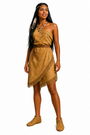
Pi is for Pocahontas.
Prompt snippets
Pocahontas is a vigorous young woman with deep, copper-toned skin and a strong, athletic build, reflecting an active outdoor life. Her face is bright and open, characterized by dark, expressive eyes, pronounced cheekbones, and a warm, steady smile. Her hair is raven-black, straight, and very long, worn flowing down her back, and adorned with a simple headband made of woven hemp. She wears a practical and elegantly simple tunic or wrap made of soft, brain-tanned deer hide. The leather is a light golden-brown hue, often fringed along the edges. The garment is sleeveless or features a single strap over one shoulder, cinched at the waist with a simple belt. She wears moccasins of the same material. For adornment, she favors natural items: necklaces made of polished Wampum beads (white and purple shell) and perhaps a single feather from a turkey or hawk subtly integrated into her hair or attire.
Characters with pi