Pinyin initial: "ch"
/ʈʂʰ/
The Pinyin initial "ch" is used in the first half of Pinyin syllables. In MandarinBanana's mnemonic system, "ch" belongs to the group of Pinyin initials which are represented in mnemonics by men. You can visit the Pinyin index to see all Pinyin syllables from this mnemonic group, or to see all Pinyin syllables "ch" can appear in.
Pronunciation Tips
The “Cheat Code”
Think of “ch” as a strong, aspirated, tongue-curled “ch”—like the “ch” in “church,” but with the tongue pulled slightly back and a clear puff of air.
Mouth Mechanics (step-by-step)
- Start with your jaw relaxed and lips neutral (no tight rounding like “shoo,” no wide smile).
- Curl the tip of your tongue slightly up and back so it points toward the front part of the roof of your mouth, just behind the bumpy ridge behind your upper teeth.
- Do not touch the teeth with the tongue tip. The tongue tip is “hovering” near the roof of the mouth; the front of the tongue forms the main contact area.
- Seal briefly, then release into a hissy burst: you make a short “stop” (a tiny blockage), then release into a fricative-like sound (a “sh”-like noise).
- Add aspiration (the key feature): when you release, let out a noticeable puff of air, like you’re trying to fog a small spot on glass—chʰ, not just ch.
- Voice stays off at the start: your vocal cords should not vibrate during the initial burst; voicing comes later with the vowel.
English Approximation (how to get close)
English does not have this exact sound in the same place in the mouth, but you can get very close:
- “church” — use the first sound (the “ch” in church).
Modification: pull the tongue a little farther back and slightly curled; then add extra air on release. - “chop” — use the “ch” in chop.
Modification: make it feel “drier” and more retracted (tongue a bit farther back), and strongly aspirated. - “train” (helpful setup) — not because it has “ch,” but because the “tr” in many American accents has a slightly “retroflex” quality.
Modification: start from that tongue shape and turn it into an aspirated “ch” release (a quick block + burst).
If your “ch” sounds too soft or too far forward, you’re probably making an English-style “ch” rather than the Chinese ch.
Common Mistakes (English speakers)
- Not enough air (no aspiration): Chinese ch needs a clear puff; otherwise it can sound closer to Chinese zh (which is similar but not aspirated).
- Tongue too far forward: if your tongue is too close to the teeth ridge (or touching the teeth), it can drift toward q/j-like territory (too “front”).
- Turning it into English “sh”: ch must start with a brief stop and then release; sh is only friction with no “pop.”
- Over-rounding the lips: especially before “-i” (as in chi), English speakers sometimes purse the lips; keep lips mostly neutral.
Practice Pairs (visual “sound-alikes”)
These English words are approximations meant to cue the feel of the sound (tongue curl + puff of air). The matching part is the starting consonant.
Pinyin (ch-) Approx. English cue What to imitate cha chop Initial ch, but with more air and tongue slightly farther back chai child Initial ch, then glide toward “ai” chao chow Initial ch, then “ow” chou choke Initial ch, then “oh” che church (start) Initial ch; keep the “ch” crisp, don’t melt into “sh” chan chant Initial ch, then “an” + final “n” (tongue ends forward) chen chunk (start) Initial ch, then a short central vowel feel + “n” chang chong (as in “Chong-”) Initial ch, then “ah” + final “ng” (back of tongue up) cheng chunk (start) Initial ch, then central vowel feel + final “ng”Tip for accuracy: keep the English cue only as a starting point; the real target is retracted tongue + stop-and-release + strong air.
Comparisons & caveats (similar Pinyin sounds)
ch vs zh (most important)
- Same tongue region and general “retroflex” quality, but:
- ch = aspirated (strong puff of air)
- zh = unaspirated (much less air, “tighter,” often perceived as more “buzzy” or “heavy”)
A simple test: hold your palm a few inches in front of your mouth—ch should blow air onto it clearly.
ch vs sh
- ch has a tiny stop closure before the hissy part (a “pop” into friction).
- sh is continuous friction with no stop.
If your sound can be sustained like “shhhhh,” you are not making ch.
ch vs q
- q is also aspirated, but it is much more forward in the mouth (tongue closer to the front, more “cheeky/bright”).
- ch is farther back with a slight tongue curl (darker, more “retroflex”).
If your “ch” starts to resemble the “ch” in “cheese” with a very fronted tongue position, you may be drifting toward q.
Special note on “chi”
In syllables like chi, the “i” is not the same as the “ee” in see. After ch, it becomes a special vowel-like sound that feels “r-colored” or “tongue-back.”
Practical cue: say ch correctly first (curl + puff), then keep the tongue pulled back rather than sliding forward into a bright “ee.”
Pinyin with ch
Mnemonics for ch
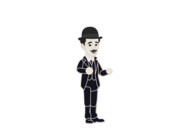
Ch is for Charlie Chaplin.

Prompt snippets
Charlie Chaplin is a slight, expressive silent film actor with a pale, melancholic face and bright, mischievous dark eyes. He is defined by his signature small, square "toothbrush" moustache and thick, wavy black hair tucked under a weathered, black felt bowler hat. He wears a distinctive, ill-fitting ensemble: a tight-fitting black tailcoat over a tattered white tuxedo shirt with a limp, crooked bow tie, paired with enormously baggy grey trousers held up by thin suspenders. His shoes are massive, oversized black leather boots that curve upward at the toes. He is consistently seen gripping a limber, curved bamboo walking cane, which he uses with acrobatic grace. His posture is slightly splayed, with feet pointed outward in a "duck-like" stance.
Characters with ch