Pinyin final: "(e)n5"
/ən/
The Pinyin final "(e)n5" is used in the second half of Pinyin syllables. In MandarinBanana's mnemonic system, the second half of a Pinyin syllable is always represented by a location. You can visit the Pinyin index to see all Pinyin syllables from this mnemonic group, or to see all Pinyin syllables "(e)n5" can appear in.
Pronunciation Tips
The “Cheat Code”
Think of the unstressed “en” sound in “golden” (the weak, relaxed “uhn” at the end), said quickly and lightly through the nose.
Mouth Mechanics (step-by-step)
- Relax your mouth first. This final is not a big “eh” sound—keep it small and neutral.
- Lips: Let them rest naturally (not rounded like “oo,” not spread like “ee”).
- Jaw: Slightly open, as if you’re saying a lazy, unstressed “uh.”
- Tongue: Keep the tongue relaxed and centered in the mouth (not pulled back, not bunched up).
- Make a short “uh” sound (very quick and unstressed).
- Close into “n” smoothly:
- Touch the tip of your tongue gently to the bumpy ridge just behind your top front teeth.
- Let the sound continue through your nose (this is what makes it an “n”).
- Stop cleanly. Don’t add an extra vowel after the “n.”
English Approximation (2–3 helpful words)
These English matches are approximations; focus on the weak, unstressed vowel plus n:
- golden → the last syllable “-den” (often sounds like “duhn”): match the relaxed “uh + n” quality.
- taken → the last syllable “-ken” (often sounds like “kuhn”): match the neutral vowel and the n ending.
- sudden → the last syllable “-den”: match the short, central vowel before n.
How to modify English to get closer:
In many English accents, “en” in these words can drift toward a clearer “eh” sound. For Mandarin -en, make the vowel more neutral (“uh”) and shorter, then close into n without extra sound.
Common Mistakes (English speakers)
- Mistake: Saying “ehn” (like “pen”) too clearly.
Mandarin -en is usually more relaxed and central than the “e” in English “pen.” - Mistake: Adding a trailing vowel: “en” → “uh-nuh” or “eh-nuh.”
End on the n; don’t release into another vowel. - Mistake: Over-opening the mouth.
A big jaw opening makes it sound too much like “an” (as in “fan”-ish). - Mistake: Turning it into “eng.”
Keep the tongue tip contact for n; don’t pull the tongue back for an “ng” sound.
Practice Pairs (visualizing the sound)
Pinyin syllable Closest English “helper” What to copy from the English word en5 golden (last syllable “-den”) The weak “uh” + n feeling at the end en5 taken (last syllable “-ken”) Keep it unstressed and short, end on n men5 men (as a starting point) Start with “men,” then relax the vowel toward “muhn” and keep the n cleanNote: The English word men is useful because it’s familiar, but its vowel is often too “eh.” Use it as a bridge: men → m(uh)n (more neutral), while keeping the final n.
Comparisons & Caveats (don’t mix these up)
-
-en vs -an
-en has a more neutral, smaller vowel (closer to “uh”).
-an sounds more open and “a”-like (bigger mouth opening). If your jaw drops a lot, you’re drifting toward -an. -
-en vs -eng
-en ends with n: tongue tip touches near the front (behind top teeth).
-eng ends with ng: the back of the tongue lifts; the tongue tip usually does not make the same front contact. If it feels like the sound is happening far back in your mouth, you’re drifting toward -eng. -
-en vs -in
-in has a higher, more “ee”-like tongue position (even if it’s not a pure English “ee”).
-en stays more central. If your lips spread and your tongue rises like “ee,” you’re drifting toward -in. -
Tone note for “5” (neutral tone)
In en5 / men5, keep it light and quick, without a strong pitch movement. The key is reduced energy, not “flat and long.”
Pinyin with (e)n5
Mnemonics for (e)n5
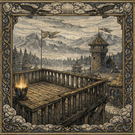
On the encampment’s roof.

Prompt snippets
Scene setting: woven into coarse wool and linen fibers with a palette of indigo, slate grey, and aged gold, this scene takes place at the top an elevated wooden watch-platform of a fortified medieval encampment. In the background of the scene are watch-towers topped with conical thatched roofs, where rigid banners bearing heraldic chevrons flutter in a frozen, geometric wind. The entire perspective-free vista is framed by an ornamental border of interwoven clouds and soaring falcons, maintaining the characteristic flat aesthetic of a traditional wall hanging.
Characters with (e)n5