Pinyin initial: "bu"
/pu/
The Pinyin initial "bu" is used in the first half of Pinyin syllables. In MandarinBanana's mnemonic system, "bu" belongs to the group of Pinyin initials which are represented in mnemonics by animals. You can visit the Pinyin index to see all Pinyin syllables from this mnemonic group, or to see all Pinyin syllables "bu" can appear in.
Pronunciation Tips
The “Cheat Code”
Think of the “b” in “spin” (a soft, unpuffed “b”), followed by an “oo” like “food,” but said short and clean.
Mouth Mechanics (step-by-step)
- Get ready for a “b/p” closure: Bring your lips together firmly (like you’re about to say English b or p).
- Keep your voice OFF at the moment of release: As you open your lips, don’t start vibrating your vocal cords immediately. This makes the sound come out like a very light “p”, not a strong English “p.”
- Do NOT add a strong puff of air: Let the air out gently. The release should feel controlled, not explosive.
- Go straight into “u” (oo): Immediately round your lips into a small circle (like “oo” in “food”).
- Keep the vowel steady and pure: Your tongue stays fairly relaxed and back in the mouth; don’t let the vowel drift into “yoo” or “uh.”
- Add the tone on the whole syllable: The consonant is quick; the tone rides mostly on the vowel.
English Approximation (what to listen for)
Chinese bu is pronounced with an initial that is closer to an unaspirated “p” than to a typical English “b.” English does not use this sound as a main category, but you can get very close.
- “spin” → the “p” in spin is soft and not strongly puffed.
- Use that soft “p” quality, but without turning it into a full English “p.”
- “spoon” → the “p” in spoon is also less airy than in poon (a made-up emphasized “p”).
- Think: sp- gives you the right “not too puffy” feeling.
- “boo” → the vowel “oo” in boo matches the u in bu fairly well.
- Keep it shorter and cleaner than a dramatic Halloween “booo!”
How to modify English to match Chinese:
Say “boo”, but replace the English b with the soft p feeling from “spin”. That combination is very close to bu.
Common Mistakes (English speakers)
- Mistake 1: Pronouncing it like a fully voiced English “b.”
English b usually has immediate voicing. In Mandarin bu, the start is typically not voiced the same way; it’s closer to a light, unpuffed “p.” - Mistake 2: Adding a big puff of air (aspiration).
Don’t make it like the p in pin (which is strongly airy). bu should feel tight and controlled, not breathy. - Mistake 3: Turning the vowel into “byoo” or “buh.”
Keep u = “oo” (rounded lips), not “you” and not “uh.” - Mistake 4: Overholding the consonant.
The lip-release is quick; the tone belongs to the vowel.
Practice Pairs (visualizing the feel)
Pinyin syllable English “helper” word What to copy from English What to change bu1 spin + boo soft p feeling (from spin), oo vowel (from boo) make it one smooth syllable: (soft p) + oo, then apply a high-level tone bu2 sponsor (first sp-) + boo gentle, unpuffed p-type release; oo vowel keep it smooth and add a rising tone bu3 spool (sp-) controlled sp- “p” (not airy) + oo vowel make the vowel carry the dip-then-rise tone (low and curved) bu4 spoon (sp-) unpuffed p quality + oo vowel add a sharp falling tone; don’t clip the vowel too early(The English words are approximations: you are borrowing the “soft p” feeling from sp- and the vowel quality from oo.)
Comparisons & caveats (similar Mandarin sounds)
- bu (b-) vs. pu (p-): same lip position, different airflow.
Both start with closed lips. The key difference is air:- b- in Mandarin (as in bu) is unaspirated: little to no puff.
- p- in Mandarin (as in pu) is aspirated: a clear puff of air after the release.
Quick test: Hold a thin tissue in front of your lips. pu should flutter it noticeably more than bu.
- bu vs. English “b”: don’t chase “buzz.”
English b often feels “heavier” and more voiced at the start. Mandarin bu begins more like a clean, quiet lip pop—then the vowel carries the sound. - bu vs. “bo/bu” confusion (u vs. o):
The vowel in bu is u = “oo”, with tight lip rounding. Don’t let it open toward “oh” (that would sound more like a different vowel category).
Pinyin with bu
Mnemonics for bu
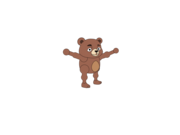
Bu is for Bruno Bear.

Prompt snippets
Bruno Bear is a massive, powerful Grizzly brown bear characterized by a distinct, muscular hump over its shoulders. It features a thick, shaggy coat of dark chocolate-brown fur with subtle silver-tipped guard hairs that give it a "grizzled" appearance. Its face has a slightly dished profile, a large wet black nose, and small, rounded ears. The bear has formidable, long ivory-colored claws protruding from heavy, wide paws, and deep-set, intelligent dark amber eyes.
Characters with bu