Pinyin initial: "yu"
/y/
The Pinyin initial "yu" is used in the first half of Pinyin syllables. In MandarinBanana's mnemonic system, "yu" belongs to the group of Pinyin initials which are represented in mnemonics by deities. You can visit the Pinyin index to see all Pinyin syllables from this mnemonic group, or to see all Pinyin syllables "yu" can appear in.
Pronunciation Tips
The “Cheat Code”
Think “ee” in see, but with rounded lips like saying “oo”, and (in many syllables) a very light “y” glide into that rounded “ee.”
Mouth Mechanics (step-by-step)
Use this as a physical recipe.
- Start with the tongue position for “ee” (like see).
- The front of the tongue is high and forward, close to the roof of the mouth (but not touching).
- Your jaw is fairly closed (not wide open).
- Now change only the lips:
- Keep the tongue in the “ee” position, but round and push the lips forward as if you’re about to say “oo” (as in food).
- This “ee tongue + oo lips” combo creates the core yu vowel quality.
- Keep it “clean” (no extra consonant):
- Do not add an English-style “r,” “w,” or “n” unless the syllable actually ends with -n or -ng.
- For syllables written with y + (u/ue/uan/un): add a tiny glide:
- In syllables like yue, yuan, yun, the sound often begins with a very short front-of-tongue glide (a quick “y”-like movement) and immediately goes into the rounded vowel.
English Approximation (how to get close)
English does not have this exact vowel as a normal standalone sound, so use modifications:
- “ew” in few / new (some accents)
- In many American pronunciations, the vowel in few or new can be close to yu, if you keep it very pure and short.
- Focus on the vowel after the “f/n,” not the consonant.
- “ee” in see + lip rounding (best controllable method)
- Say see (hold the ee), then round your lips without moving your tongue much.
- The sound should shift into the target yu quality.
- French “u” trick (if you’ve heard it):
- If you’ve ever heard the French vowel in tu or lune, it’s extremely close.
- For English speakers, the reliable path is still: “ee tongue” + “oo lips.”
Common Mistakes (English speakers)
-
Mistake 1: Saying “yoo” (like you) too strongly.
English you often has a stronger “y” glide and can drift toward a “w/oo” feeling. Chinese yu should feel tighter and more fronted (more “ee-like” in the tongue). -
Mistake 2: Using the “oo” tongue instead of the “ee” tongue.
If your tongue backs up like food, you’ll get something closer to u (Chinese u) rather than yu. -
Mistake 3: Adding an “r” coloring.
Avoid turning it into anything like “yur”. -
Mistake 4: For -n / -ng endings, over-pronouncing an English-style final consonant.
The ending should feel smooth and nasal, not like a hard, released n or g.
Practice Pairs (visual + sound targeting)
These English words are approximations. The goal is to match the mouth shape: “ee tongue” + “oo lips,” and keep the sound pure.
Pinyin (target) English approximation What to copy from English yu few (vowel) The “ew” vowel quality, but keep it purer (less glide) yue you-eh (said smoothly) A quick front glide into an “eh”-like vowel (keep it one syllable) yuan you-en (said smoothly) Quick glide + rounded vowel, then a light -n nasal ending yun yewn (like “ew” + n) The rounded ‘ew’ feeling, then -n yong young Similar overall sound; copy the “y + uh + ng” flow (don’t overdo the “uh”)Comparisons & Caveats (similar pinyin to watch out for)
A) yu vs u (the #1 confusion)
- yu: tongue is forward like “ee”, lips rounded.
- u (as in lu, du, gu): tongue is backer like “oo”, lips rounded.
Quick test: If it feels like the vowel in food, you probably made u, not yu.
B) yu vs yi
- yi is basically a clean “ee” with relaxed lips (not rounded).
- yu keeps the same tongue idea but adds strong lip rounding.
C) yue / yuan / yun: the “front + rounded” family
These syllables are not “y + u + e/an/n” as separate chunks. They behave like a single blended syllable:
- yue: a short glide into a rounded front vowel, then toward an “eh”-type vowel.
- yuan: similar blend, ending with -n (nasal).
- yun: rounded front vowel plus -n.
D) yong is different from the “yu/yue/yuan/yun” group
Even though it’s written with y-, yong uses a different vowel quality (like English young), not the tight rounded-front yu vowel.
So don’t try to force “ee tongue + oo lips” for yong—aim for the young-like sound with a Chinese tone.
Pinyin with yu
Mnemonics for yu
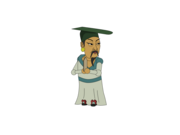
Yu is for Yu the Great who tamed the floods.

Prompt snippets
Yu the Great is a powerful, robust Chinese man in his prime, with a weathered, muscular physique and an intense, focused expression of stoic determination. He has rugged, deep-set dark eyes and a prominent, furrowed brow ridge, showing the strain of endless labor. His thick, unkempt black hair and dense beard are pulled back roughly in a functional, dishevelled top-knot with a simple wooden clip. He is dressed not in fine robes, but in practical, worn work attire suitable for a laborer-king: a tattered, muddy cross-collar tunic of coarse grey hemp, layered over rugged dark trousers and stout, muddy straw sandals with thick soles. A heavy, frayed straw rain-cape (蓑衣 - suōyī) is tied across his shoulders. Most importantly, he is gripping a large, utilitarian iron digging hoe (lei-si)—his primary tool for dredging canals. A heavy bronze medallion embossed with a stylized wave pattern hangs around his neck.
Characters with yu