Pinyin initial: "cu"
/tsʰu/
The Pinyin initial "cu" is used in the first half of Pinyin syllables. In MandarinBanana's mnemonic system, "cu" belongs to the group of Pinyin initials which are represented in mnemonics by animals. You can visit the Pinyin index to see all Pinyin syllables from this mnemonic group, or to see all Pinyin syllables "cu" can appear in.
Pronunciation Tips
The “Cheat Code”
Think of “ts” in “cats”, but make it strongly aspirated (a clear puff of air), then add “oo” as in “food.”
Mouth Mechanics (step-by-step)
-
Start position (tongue + teeth):
Lightly touch the tip of your tongue to the bumpy ridge just behind your upper front teeth (the “tooth ridge”). Keep the tongue centered—not curled back. -
Seal briefly (like a “t”):
Make a small stop by pressing the tongue tip there for a moment, as if beginning an English “t” at the tooth ridge. -
Release into a tight hiss (like “s”):
Release the tongue so the air squeezes through a narrow groove along the center of the tongue. You should get a “ts”-type sound (a quick “t” + “s” together). -
Add strong aspiration (the key feature):
As you release, send out an extra burst of breath.
A good self-check: hold your palm a few inches in front of your mouth—you should feel a clear puff of air. -
Move smoothly into the vowel “u” in “cu”:
After the “ts” release, immediately form tight, rounded lips (small “oo” shape). The tongue body stays relatively high, and the sound continues into “oo”.
English Approximation (how to get close)
English does not have this exact starting consonant as a single “letter sound,” but it’s easy to build from familiar pieces:
-
cats → focus on the “ts” at the end: cats
Make that same “ts” sound, but put it at the beginning and add a strong puff of air: tsʰ + oo → “(t)s-oo.” -
tsetse (as in “tsetse fly”) → focus on the starting “ts”
Many English speakers pronounce it with a clear “ts” at the beginning. Add more breath (aspiration) and then “oo.” -
pizza → focus on the “ts” sound some speakers make in the middle (“pi-tsa”)
Use that “ts” quality, but make it crisper, more forward at the tooth ridge, and more aspirated.
Important adjustment: English “ts” (like in cats) is usually not very aspirated. For Mandarin c-, you must add that extra burst of air.
Common Mistakes (English-speaker traps)
-
Mistake 1: Saying “sue” (starting with plain S).
cu must start with a quick “t” release into “s” (“ts”), not a soft continuous “s.” -
Mistake 2: Saying “zoo” (voicing it).
Don’t let your vocal cords buzz at the start. The beginning should be breathy and crisp, not “z-.” -
Mistake 3: Not enough aspiration (no puff of air).
Without the puff, you drift toward Mandarin z- (which is much less breathy). For c-, the air burst is essential. -
Mistake 4: Pulling the tongue too far back (making it sound like “ch-”).
Keep the tongue tip forward at the tooth ridge. Don’t curl it back.
Practice Pairs (visualizing the sound)
Pinyin syllable English “anchor” (approx.) What to copy from the English word cu cats (the ending) Use the final “-ts”, move it to the front, add a puff of air, then “oo” cuo “ts” + “woah” Start with aspirated “ts”, then glide into a “wo”-like vowel cui “ts” + “way” Start with aspirated “ts”, then glide into “way” (quick “w”-like glide) cuan “ts” + “wan” Start with aspirated “ts”, then say “wan” smoothly cun “ts” + “one” (said quickly) Start with aspirated “ts”, then a short central vowel (like a relaxed “uh”) + “n” cong “ts” + “oo” + “ng” Start with aspirated “ts”, then a short “u” vowel, ending in “-ng”Note: These English anchors are approximations to help you aim your mouth and airflow. The Mandarin target is more precise and consistent.
Comparisons, similar sounds, and caveats to watch out for
A) c- vs z- (the most important contrast)
- c- has a strong puff of air after the “ts” release.
- z- is similar in tongue position but has little to no puff of air.
Test: Put your palm in front of your mouth. c- should feel noticeably airier.
B) c- vs s-
- s- is a continuous hiss (no “t” closure).
- c- begins with a tiny stop then releases: “t + s” together.
If you can hold the sound from the very beginning like a long “ssss…,” you’re probably saying s-, not c-.
C) c- vs ch- (don’t retreat too far)
- c- is made forward near the upper teeth/tooth ridge (a “ts” feel).
- ch- is made farther back and often feels more “rounded” or “retroflex” for many learners.
If it starts to sound like English “ch” in chair, your tongue is likely too far back.
D) The “u” after c- changes shape in different syllables
The initial c- stays the same, but what comes after it can include a quick w-like glide:
- cu: straight into a tight “oo”.
- cuo / cuan / cun / cong / cui: you’ll often feel a brief w-style lip rounding leading into the main vowel (that’s normal). Keep the c- crisp and aspirated, then glide smoothly.
E) Keep the consonant short; let the vowel carry the syllable
English speakers sometimes “over-hiss” the s part. In Mandarin, the c- is quick and clean, and the vowel portion is where the syllable really opens up.
Pinyin with cu
Mnemonics for cu
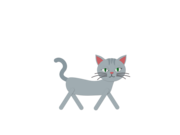
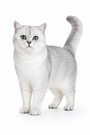
Cu is for Kitty Cat.
Prompt snippets
Kitty Cat is a plush, sturdy British Shorthair with a brilliant silver shaded coat. The fur is a dense, crisp white undercoat tipped with fine shimmering charcoal-silver, giving the cat a metallic, luminous sheen. She has a distinctive round face with chubby cheeks and large, wide-set brilliant emerald green eyes outlined in natural black "eyeliner." Her nose is a soft brick-red.
Characters with cu