Mnemonic comic for

Translation

bāo = b + ao1: archaic variant of 包[bao1]

Mnemonic

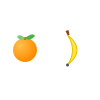
勹 looks like an elephant: 丿 looks like the edge of the ear and ㇆ looks like the head and trunk.

Beelzebub (b) rides an elephant in front of the aorta (ao1), turning the soil with a plow (㇆). Lots of bananas (丿) are revealed in the turned earth.

Loading...

Comments

Here we see the plow in action together with the banana to form 勹, which reminds me of an elephant: 丿 looks like the ear, and 亅 looks like the trunk.

As for the pronunciation: "b" is represented by Beelzebub. Pinyin initials without "special" vowels (i, u, ü) are represented by men. The Pinyin final "ao" is represented by the aorta, the largest artery in the human body. You can see it behind Beelzebub riding on the elephant.

As a reminder, here's the key how to remember the tone of the Pinyin final:

1 -> in front of
2 -> in the kitchen
3 -> in the living room
4 -> in the bathroom
5 -> on the roof

Matthias, almost 3 years ago

勹 character breakdown

Component Translations
丿
piě = pi + e3
radical in Chinese characters (Kangxi radical 4) / see 撇[pie3]
Loading...
Loading mnemonics…
Character component without intrinsic meaning
Loading...
Loading mnemonics…

Characters with 勹 as component

sháo = sh + ao2
spoon / ladle / CL:把[ba3] / abbr. for 公勺[gong1 shao2], centiliter (unit of volume)
Loading...
Loading mnemonics…
= w + Ø4
Loading...
Loading mnemonics…
xún = xu + (e)n2
ten days / ten years / full period
Loading...
Loading mnemonics…

Words with 勹

勹 is not used as a component in another word.
Sentences with 勹
勹 currently does not appear in any sentence.

Prompt snippets

The elephant is a wrinkled, slate-grey African bush elephant. It has large, fan-shaped ears, a thick, muscular trunk, and two curved, ivory tusks.

AI Images